Understanding what public liability insurance cover is a fundamental step for any business owner, sole trader, or independent contractor operating in Australia. Public and product liability insurance is designed to protect your business against the financial risks of third-party claims for accidental injury or property damage caused during your standard operations. This guide explains exactly what is covered by a standard policy, what remains excluded, and how the insurance responds when an unexpected accident occurs.
Every commercial operation faces daily exposure to risk, whether clients visit dedicated premises, or work is performed on a customer site. A single legal claim resulting from a slip, trip, or property mishap can result in substantial out-of-pocket costs that threaten the survival of an unprotected business. Holding a valid policy helps safeguard business revenue while satisfying the contractual demands of clients and principal contractors.
To explore how these safeguards integrate into your specific business setup, you can access the upcover sole trader insurance options.
TL;DR
- Core Coverage Protections: Public and products liability insurance primarily covers third-party personal injury, third-party property damage, and the associated legal defence costs.
- The Product Liability Mechanism: In Australia, public liability is almost universally packaged with products liability, which covers damage or injury caused by items your business sells or supplies.
- Standard Policy Exclusions: This insurance does not cover injuries to your own employees, damage to your own business property, or financial losses stemming from professional advice.
- Flexible Cover Limits: Australian businesses commonly select cover limits of $5 million, $10 million, or $20 million based on their industry risk and client contract terms.
- The upcover Framework: upcover arranges insurance for more than 70,000 businesses across Australia with a 4.9/5 customer rating, mapping over 4,000 occupations with instant Certificates of Currency.
What Is Public and Products Liability Insurance?
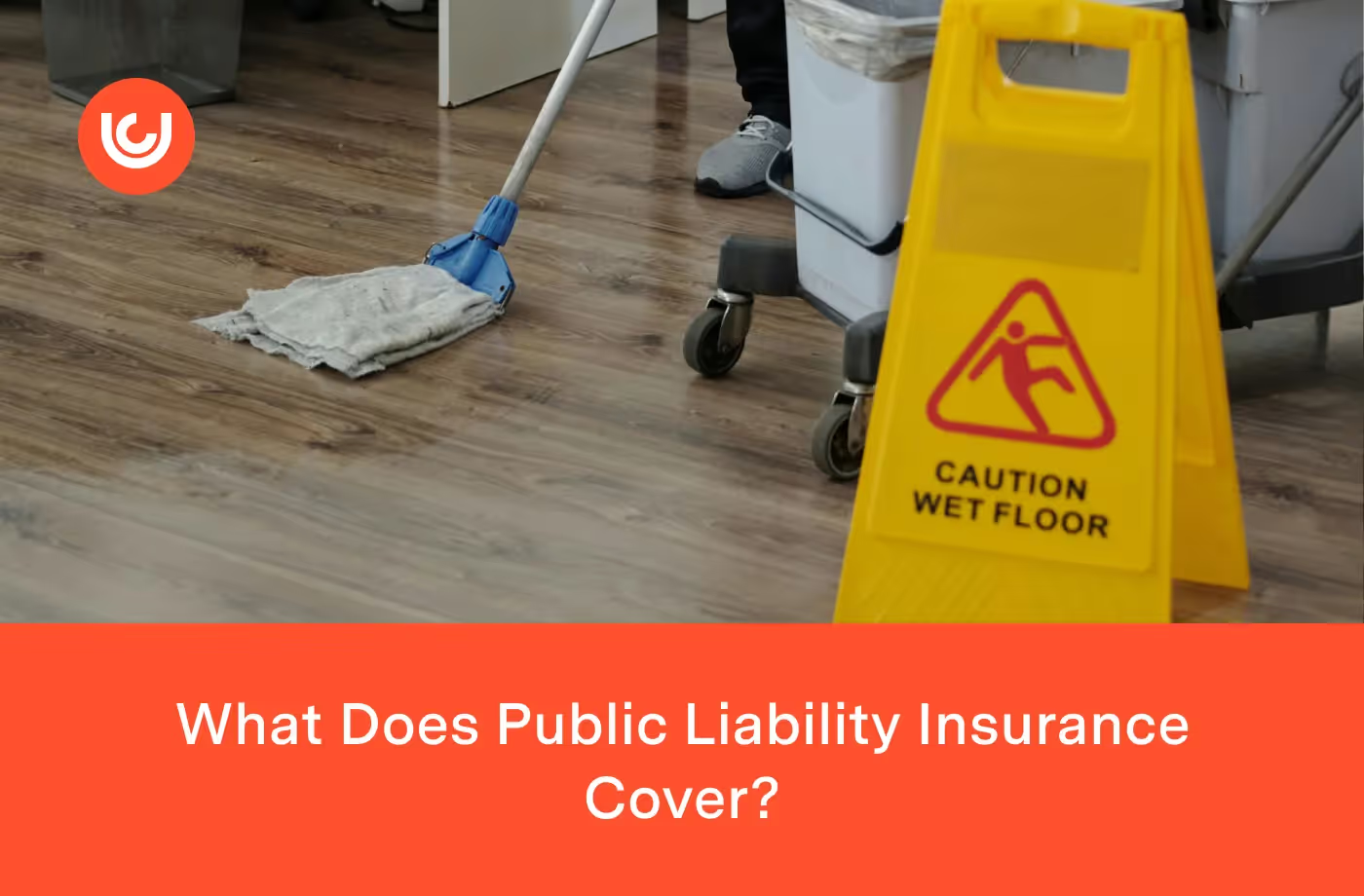
Public and products liability insurance operates as a combined policy in the Australian insurance market to cover two distinct types of third-party liability risk. The public liability component handles incidents arising from your physical business activities and presence, such as a customer slipping on a wet floor inside a workshop. The products liability component addresses property damage or bodily injury caused specifically by products your business manufactures, alters, sells, or supplies, such as a batch of food causing illness or a distributed component failing and damaging external property.
Contractors and sole traders frequently find that principal clients require proof of this coverage before allowing work to commence on site. When you hold this policy, the insurer steps in to manage the financial repercussions of covered third-party demands, subject to policy terms. This prevents a single operational mistake from translating into a corporate debt.
What Does Public Liability Insurance Cover for Your Business?
A standard commercial policy addresses three major components of a third-party claim, ensuring that your business asset base remains insulated during litigation.
Third-party personal injury claims
If a customer, delivery driver, or member of the public sustains a bodily injury, illness, or accidental death due to your business operations, the policy may help cover the resulting costs. This includes covering medical expenses, rehabilitation costs, and court-awarded compensation for pain, suffering, and loss of income, depending on the specific policy terms. It is important to note that this applies only to third parties, not to you or your staff members.
Third-party property damage claims
When business activities accidentally cause damage to property belonging to a client or a member of the public, the policy may include cover for the repair or replacement costs. This applies whether the damage occurs at your permanent office or while working on-site at a customer location. For example, a technician accidentally spilling liquid on a client's main server framework would trigger this section of the policy.
Legal defence and litigation costs
Defending a liability claim in an Australian court is an expensive process, even if your business is ultimately found innocent of negligence. Public liability insurance covers the legal fees required to mount a defence, including hiring lawyers, investigator fees, and court administrative costs. The insurer typically manages the legal process directly, reducing administrative strain on the business owner.
Scenario 1: A beauty salon owner leaves a small pool of water near the entrance after cleaning an equipment station. A client enters the premises for an appointment, slips on the slick surface, and sustains a fractured wrist. The client makes a claim for medical costs and lost wages due to the injury. Public and products liability insurance may help cover the medical bills and legal settlement costs, subject to policy terms.
Scenario 2: A mobile technician is servicing a residential air conditioning unit and accidentally drops a heavy tool container onto a client's imported marble flooring, causing deep cracks. The property owner demands full replacement of the damaged tiles, costing thousands of dollars. Public and product liability insurance may include cover for the property restoration expenses, subject to the terms of your specific policy.
Illustrative scenario only. Coverage depends on the terms of the individual policy.
What Does Public Liability Insurance NOT Cover?
To ensure your business has no hidden exposure, it is vital to recognize the standard exclusions that are never covered under a public liability framework.
Professional advice and services
Claims resulting from incorrect advice, bad design, or professional negligence are entirely excluded from public liability. If a business provides consultancy, design layout, or specialized training, protection against financial losses requires a standalone Professional Indemnity Insurance policy.
Injuries to your own staff
Employee injuries are generally handled through workers compensation. Contractor and subcontractor injuries depend on the working arrangement, worker/deemed-worker rules, and policy wording. Workers compensation schemes are administered by state bodies such as icare (NSW) and WorkSafe Victoria. Public liability insurance is designed for third-party claims, not for your own workforce.
Damage to your own business assets
Public liability is strictly a third-party protection mechanism. If your own tools, commercial vehicles, office electronics, or stock are stolen, burnt, or broken, this policy will not pay for repairs. Property and asset protection requires a dedicated property or Business Pack Insurance setup.
Cyber attacks and data breaches
Digital liabilities, such as ransomware demands, data breaches involving customer details, or business interruption due to a network hack, are excluded. Protecting electronic assets and covering financial fallout from digital threats requires dedicated cyber insurance coverage.
How Much Public Liability Cover Level Does Your Business Setup Need?
In Australia, insurers generally offer public liability cover levels starting at $5 million, scaling up to $10 million and $20 million limits. Deciding on the correct level depends primarily on your industry type, your business size, and the specific contracts you sign with clients.
- $5 Million Limit: Often chosen by low-risk, home-based sole traders or micro-businesses that do not interface heavily with the general public or work on high-risk industrial sites.
- $10 Million Limit: The standard benchmark requested by commercial landlords for retail shop leases, and by many corporate clients before onboarded contractors can enter premises.
- $20 Million Limit: Frequently mandatory for tradespeople working on government contracts, major shopping centres, public infrastructure, or within high-risk sectors like mining and transport.
Reviewing your contractual agreements carefully ensures that you select a limit that meets or exceeds the baseline requested by your clients, preventing any onboarding delays. For a breakdown of which professions need PL and at what level, see our guide by profession.
How Much Does Public Liability Insurance Cost in Australia?
The table below shows indicative annual costs and standard coverage limits for public liability insurance across various small business sectors.
Public Liability Cover Limit Options
| Cover limit option |
Common target audience |
Typical annual cost range |
Core protection areas |
| $5 Million Cover Limit |
Micro-businesses, consultants, home offices |
$300 – $600 |
Third-party injury & basic property damage |
| $10 Million Cover Limit |
Retailers, local trades, service providers |
$450 – $900 |
High-traffic public risks & landlord mandates |
| $20 Million Cover Limit |
Commercial builders, government contractors |
$700 – $1,500+ |
Industrial sites & major commercial contracts |
Cost ranges above are indicative, based on 2026 Australian insurance market data. Your actual premium depends on your occupation, annual revenue, the cover level you select, your claims history, and your state.
Business insurance premiums are generally tax-deductible to the extent they relate to earning assessable business income under section 8-1 of the Income Tax Assessment Act 1997. Confirm the exact treatment with a registered tax agent.
About upcover
upcover is a digital-first insurance broker helping Australian small businesses arrange the right insurance instantly online. upcover arranges public liability, professional indemnity, and personal accident cover for small business owners and independent contractors across Australia.
- 70,000+ businesses covered across Australia.
- 4.9/5 customer rating.
- 80+ insurance partners providing flexible choices.
- 4,000+ occupations covered nationwide.
- Instant Certificate of Currency on policy confirmation.
upcover Pty Ltd ABN 17 628 197 437 is a Corporate Authorised Representative (CAR 1299211) of Experience Insurance Services Pty Ltd ABN 41 657 596 506, AFSL 539078.
Frequently Asked Questions
What does public liability insurance cover?
Public liability insurance covers your business against the financial costs of third-party claims for accidental bodily injury or third-party property damage caused by your operational activities. It also covers the associated legal defence and court costs required to handle a dispute, subject to policy terms.
What is the difference between public liability and product liability?
Public liability covers incidents stemming from your operational actions and physical business presence, such as a customer tripping over an unsecured cable. Products liability covers third-party injury or damage caused specifically by an item your business has manufactured, supplied, or sold, depending on the specific policy terms.
Does public liability insurance cover my own tools or injuries?
No, public liability insurance is designed exclusively for third-party claims, meaning it never covers your own personal injuries or damage to your own business assets. To protect your tools and equipment, you must arrange a separate property cover, while personal injuries require personal accident insurance, subject to individual policy terms.
Is public liability insurance legally compulsory for small businesses in Australia?
While public liability insurance is not universally mandated by Australian federal law for every industry, it is practically required to operate. Most commercial landlords, industry associations, corporate clients, and government contracts make holding a valid Certificate of Currency a mandatory condition of doing business.
What does public liability insurance not cover?
Public liability insurance does not cover employee injuries, damage to your own business property, intentional illegal acts, or cyber data breaches. It also strictly excludes financial losses caused by errors in your professional advice, which instead require a dedicated professional indemnity policy, subject to policy terms.
Can I claim my public liability insurance premium as a tax deduction?
Yes, business insurance premiums are generally tax-deductible to the extent they relate to earning assessable business income under section 8-1 of the Income Tax Assessment Act 1997. The exact treatment depends on your circumstances, so confirm with a registered tax agent.
The information in this article has been prepared without taking into account your individual needs, objectives or financial situation. It should not be relied upon as personal advice. All insurance products arranged through upcover are subject to the terms, conditions, limits and exclusions contained in the relevant policy wording and Product Disclosure Statement. Before deciding whether a particular insurance product is right for you, please read the relevant PDS and consider your personal circumstances. References to legislation, professional association requirements, private health fund eligibility and state workers' compensation schemes are general in nature and current at the time of writing. Always confirm the current position with the relevant body. upcover Pty Ltd ABN 17 628 197 437 is a Corporate Authorised Representative (CAR 1299211) of Experience Insurance Services Pty Ltd ABN 41 657 596 506, AFSL 539078. upcover arranges insurance products with selected insurers and underwriters and does not compare all general insurers or insurance products available in the market.

.svg)



.svg)
.svg)
.svg)
%201.svg)


.svg)



.svg)


