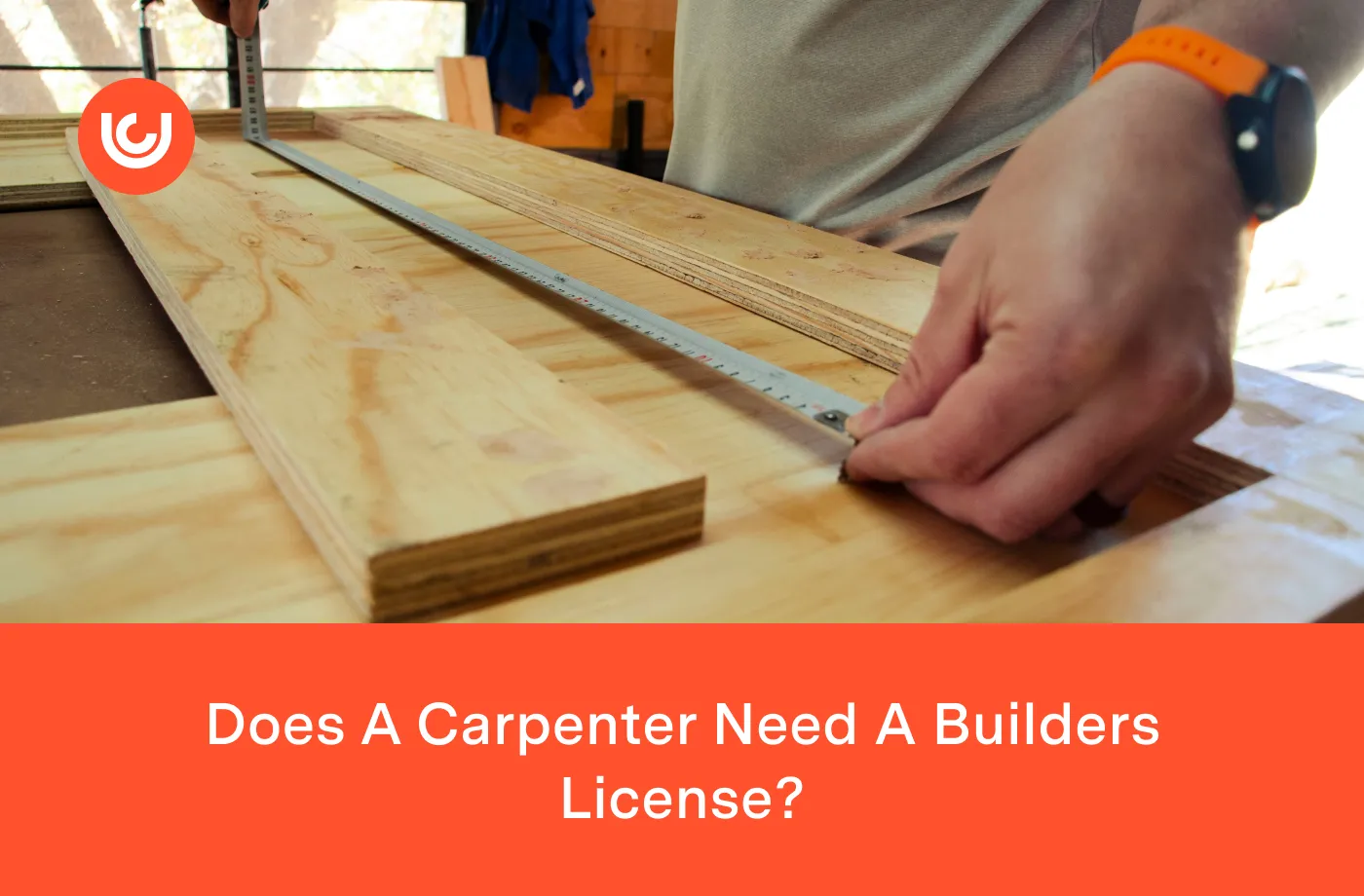
Does a carpenter need a builder's licence? It depends on the state or territory, the value and type of work and whether you contract directly with the client.
In NSW and Queensland, carpentry has its own licence class. In Victoria, carpentry sits within a limited domestic builder class. In the ACT, "Trades like carpenters and bricklayers do not currently need a licence".
Rules and thresholds change, so check with the regulator in your state or territory before you quote.
What are the carpenter licence rules in each state and territory?
Each state and territory regulator sets its own rules and thresholds, as listed in September 2026.
- NSW: Building Commission NSW requires a contractor licence for residential building or trade work, including carpentry, valued at "more than $5000 in labour and materials (including GST)".
- Queensland: QBCC requires a licence for building work "valued over $3,300", including "materials, labour and GST", regardless of who supplies the materials. Carpentry has its own licence class.
- Victoria: The Building and Plumbing Commission requires a registered builder for domestic building work worth more than $10,000, including labour, building materials and GST.
- Western Australia: Building and Energy requires building contractor registration for specified builder work requiring a building permit in a prescribed area, worth "$20,000 or more", or "$50,000 or more if the work relates to a Class 10a building", such as a shed or carport. GST treatment was not stated in the source.
- South Australia: Consumer and Business Services requires individuals and businesses to be licensed as building contractors. Carpenters undertake specified building work, which requires at least $10,000 in net assets to apply. No minimum job-value threshold was stated.
- Tasmania: Carpentry is not listed separately among licensed occupations on the cited CBOS pages. Builder licences have four categories: Open, Medium Rise, Low Rise and Domestic. No dollar threshold was identified in the cited pages.
- ACT: Carpenters do not currently need a trade licence. Builder licences run from Class A to Class D under the Construction Occupations (Licensing) Act 2004. No carpentry-specific dollar threshold was mentioned.
- Northern Territory: The Building Practitioners Board requires building contractor registration for prescribed residential building work, such as a Class 1a house. The Board states "$25,000 or above", while NT Government guidance says "worth more than $25,000". Commercial registration also applies from 15 April 2025. GST treatment was not stated.
In Queensland, timber the client buys still counts toward the value of the work. For NSW licence classes, costs and how to apply, see our guide to the NSW contractor licence.
Does a carpenter need a builder's licence or a carpentry licence?
Whether a carpenter holds a carpentry licence or a builder's licence depends on how the state or territory licenses carpentry. Building Commission NSW lists carpentry and joinery as separate trade work classes, apart from "General building work". Queensland's QBCC issues a carpentry licence in contractor, nominee supervisor, site supervisor and company types.
In Victoria, a person in a Domestic Builder Limited class "can only do certain types of domestic building work, for example, carpentry or glazing".
What counts as carpentry work?
Building Commission NSW defines carpentry as "cutting and placing timber (or timber composites) for on-site construction work". That includes framing and fixing components "such as stairs, windows, doors, floors and wallboards".
Building Commission NSW excludes plasterboard, "which is dry plastering work". For plastering, see does a plasterer need a builder's licence.
QBCC's carpentry licence scope includes "Install windows and doors including framing" and "Fix internal linings, panelling and mouldings". Western Australia lists "Joinery (second fixing) work" as exempt from building contractor registration.
Does a carpenter need a licence as a subcontractor?
Whether a subcontractor needs their own licence or registration differs between states and territories. Western Australia exempts a subcontractor of a registered building contractor that "is supervising the work" and "is named as the builder on the building permit".
South Australia takes a different approach. Its licence rule names "subcontractors if they run a business that carries out or organises building work".
In Queensland, QBCC says "You need an appropriate contractor licence for the subcontracted building work you undertake for a licensed builder". For a subcontractor to a licensed trade contractor, QBCC says "In most cases, you don't need a licence". In NSW, a contractor licence is needed to "carry out, advertise or contract for residential building work" valued at more than $5000.
When does a carpenter break the licensing rules?
In Queensland, QBCC says applicants "must not quote or tender on a job until your licence has been granted and is showing as active".
In Queensland, working outside your licence's scope falls under the same offence as having no licence. QBCC says the offence can be committed "by someone who is working outside of what their licence allows them to do".
Advertising has its own rules in NSW: "The licensee's name and licence number must be shown in all advertising". The regulator for your state or territory can confirm the penalties for unlicensed work.
Can a carpenter become a licensed builder?
A carpenter can apply for a builder licence or registration class, and each state and territory sets its own requirements. The CPC30220 Certificate III in Carpentry says jurisdictions "may have different licensing, legislative, regulatory or certification requirements".
Two examples of builder classes, as listed in September 2026:
- Victoria: The BPC lists a technical referee form for the Domestic Builder Limited to carpentry class. It says it will move technical referee reports online on 15 October 2026.
- Tasmania: The CBOS Domestic category applies to "Class 1 or Class 10 buildings" and some Class 2 buildings.
If you plan to run a carpentry business rather than take on whole builds, see how to start a carpentry business. For small jobs, see what a handyman can do without a licence.
Which qualification and induction unit apply to carpenters?
The national training register, training.gov.au, lists CPC30326 Certificate III in Carpentry, "a trade qualification for carpenters", as the replacement for CPC30220. It maps the two as equivalent.
General construction induction training, known as white card training, "is mandatory for any person carrying out construction work". The unit that meets this requirement is CPCCWHS1001 Prepare to work safely in the construction industry. Safe Work Australia says "White cards are recognised Australia-wide".
For the trade pathway, see how to become a carpenter in Australia.
Does a builder's licence change a carpenter's insurance?
If you move from carpentry into builder work, the activities on your policy schedule may change. A policy is designed to respond to the activities described on your policy schedule. If a customer makes a claim about an activity your schedule leaves out, the insurer may consider declining it if they were not aware of the activity and would not have accepted it as covered under the insurance policy.
Builders and head contractors may also ask for evidence of insurance before you start. Our guide to carpenter insurance in Australia explains what builders commonly ask for. An upcover team member or an insurance broker can talk through what has changed.
How upcover can help
upcover arranges insurance for carpenters. upcover works with 80+ insurance partners and can arrange quotes from a range of insurers.
- 70,000+ businesses covered across Australia
- 4.9/5 customer rating
- 80+ insurance partners
Get a quote for carpenter insurance.
Frequently asked questions
Does a carpenter need a builder's licence to build a deck?
A deck may need a licence or registration, depending on its value and the state or territory. In Queensland, building work "valued over $3,300", counting materials, labour and GST, needs a QBCC licence. In Western Australia, "timber decking" is on Building and Energy's list of work exempt from building contractor registration.
Can a carpenter build a house?
Building a whole house generally sits with a builder licence or registration class. The Northern Territory's Building Practitioners Board says a Building Contractor Residential (Restricted) registration "is required for the construction of: a Class 1a detached house". That applies where the work is "$25,000 or above".
A carpenter can still do the carpentry on a house under the rules for carpentry work in their state or territory.
Does a carpenter need a licence to work as a subcontractor?
Whether a subcontractor needs a licence depends on the state or territory. Western Australia exempts a subcontractor of a supervising registered building contractor named as the builder on the building permit. In Queensland, QBCC says "You need an appropriate contractor licence for the subcontracted building work you undertake for a licensed builder".
Is a carpentry qualification the same as a carpenter licence?
A qualification shows your training, and a licence or registration comes from the regulator in your state or territory. Building Commission NSW, for example, lists "CPC30220 Certificate III in Carpentry" among the qualifications for a carpentry licence. Its replacement on training.gov.au is CPC30326 Certificate III in Carpentry.
Does a carpenter need a licence for small jobs?
Small jobs may fall under a threshold, depending on the state or territory. QBCC exempts handyman work "as long as the value is no more than $3,300, isn't electrical or plumbing work and doesn't require an occupational licence". South Australia's licence page states no minimum dollar value.
Written by upcover's editorial team. This article provides general information only and does not take into account your objectives, financial situation or needs. It is not legal advice: get legal advice about your licensing obligations. Licensing and registration rules, thresholds and penalties are set by each state and territory and may change, so confirm what applies to your work with the relevant regulator before you quote or contract. Qualification codes may change when training packages are updated. Insurance availability and cover are subject to underwriting and the terms, conditions, limits and exclusions of the relevant policy. Read the policy wording and its terms and conditions before deciding. upcover arranges insurance products with selected insurers and underwriters and does not compare all general insurers or insurance products available in the market.