Select how you’d like to proceed with your insurance needs.
Talk to a real insurance expert on your time.
15-minutes consultation with licensed advisors
Perfect if you’re unsure about coverage needs
Get personalised recommendations
Already have coverage? Let’s simplify your service
Keep your current carriers & policies
Simple digital authorisation process
Seamless transition to better service
Help protect your business with tailored cyber liability insurance, covering 4,000+ industries, safeguarding data, finances and reputation, with expert breach response support.
Cyber insurance is built to help protect your business from risks like hacking, phishing, extortion, scams and data theft. A policy designed to cover crisis management, legal fees, investigations, ransom and recovery, helping you bounce back quickly.
At upcover, we connect you with cyber and technology cover that can reduce out-of-pocket costs for disputes and legal issues, so you can keep running your business without risking your savings.
Cyber incidents can hit everyday business tools Australians rely on, like email, cloud systems and online payments. When something goes wrong, the cost is not just the tech fix. You may also face downtime, lost income, customer notifications and pressure on your reputation.
Cyber insurance may help with response costs, recovery costs and covered claims after a cyber event, depending on the policy wording. It can also be relevant if clients, suppliers or contracts ask for proof of cyber cover before you start or renew work.
Cyber insurance is built to help protect your business from risks like hacking, phishing, extortion, scams and data theft. A policy designed to cover crisis management, legal fees, investigations, ransom and recovery, helping you bounce back quickly.
At upcover, we connect you with cyber and technology cover that can reduce out-of-pocket costs for disputes and legal issues, so you can keep running your business without risking your savings.
Cyber incidents can hit everyday business tools Australians rely on, like email, cloud systems and online payments. When something goes wrong, the cost is not just the tech fix. You may also face downtime, lost income, customer notifications and pressure on your reputation.
Cyber insurance may help with response costs, recovery costs and covered claims after a cyber event, depending on the policy wording. It can also be relevant if clients, suppliers or contracts ask for proof of cyber cover before you start or renew work.
Businesses
Customer Rating
Insurance Partners
Businesses covered
Coverage highlights
Here’s what this policy typically helps with. Exact cover depends on your insurer and policy wording.
Structured to respond to losses and response costs if an employee or contractor intentionally causes a data breach or system compromise.
Provides protection against threats to access, lock or publish your data, including expert response, negotiation support and ransom payments.
Built to respond to forensic, legal and notification costs when customer data is exposed, including credit monitoring and identity restoration.
Intended to protect against ransomware attacks, ransom payments where legally permitted, and lost income or extra costs if systems are forced offline.
Designed to cover loss of money when scammers trick you into transferring funds through phishing emails, fake invoices or impersonation attacks.


Structured to respond to losses and response costs if an employee or contractor intentionally causes a data breach or system compromise.

Provides protection against threats to access, lock or publish your data, including expert response, negotiation support and ransom payments.

Built to respond to forensic, legal and notification costs when customer data is exposed, including credit monitoring and identity restoration.

Intended to protect against ransomware attacks, ransom payments where legally permitted, and lost income or extra costs if systems are forced offline.

Designed to cover loss of money when scammers trick you into transferring funds through phishing emails, fake invoices or impersonation attacks.
Claims examples
Simple, real-world examples to help you better understand how coverage might work with this policy.
Your agency builds a plugin for a client’s website. A coding mistake exposes an admin page and the client’s database is accessed. The client claims your work caused their loss and demands you pay legal costs and damages.
Cover may include claim expenses and damages you are legally obligated to pay if a client alleges your tech services error caused loss.
Your ecommerce site is hit by a denial of service attack on a busy weekend. Customers cannot check out and your staff cannot access cloud systems. You lose sales and pay for extra IT help to restore service and keep orders moving.
Cover may include lost income and extra costs if your systems are interrupted by a covered incident, after the waiting period.
A laptop with customer records is stolen from a car. You later learn the files were accessed. You need forensic help, legal advice, customer notices and credit monitoring. A customer alleges you failed to protect their data.
Cover may include breach response costs (forensics, legal advice, notifications) and cyber liability insurance for claims from others.
A staff member clicks a fake invoice link. Ransomware encrypts your laptops and server and a note demands payment. You cannot access bookings, invoices or files for two days while experts help you contain the attack.
Cover may include cyber extortion expenses and breach response support to investigate, contain and recover, with insurer consent.
A support worker gave a participant the wrong medication due to a mislabeled pillbox. The participant experienced severe drowsiness and dehydration, requiring overnight hospitalization.
Costs included $8,200 for hospital and rehabilitation, $12,500 for legal defence, and a $7,500 settlement to resolve the claim out of court.
A support worker gave a participant the wrong medication due to a mislabeled pillbox. The participant experienced severe drowsiness and dehydration, requiring overnight hospitalization.
Costs included $8,200 for hospital and rehabilitation, $12,500 for legal defence, and a $7,500 settlement to resolve the claim out of court.
A support worker gave a participant the wrong medication due to a mislabeled pillbox. The participant experienced severe drowsiness and dehydration, requiring overnight hospitalization.
Costs included $8,200 for hospital and rehabilitation, $12,500 for legal defence, and a $7,500 settlement to resolve the claim out of court.
Important: Scenarios are examples only. Coverage is subject to policy terms, conditions and exclusions. Limits and sub-limits might apply. Policy wordings vary between insurers. Refer to the PDS or Policy Wording for details.
Benefits
Get quotes in minutes, adjust your cover as your business evolves, and lean on expert support to help you make confident insurance decisions.
Who it’s for
Types of businesses who might be contractually required or recommended to take out this insurance.
Tech businesses rely on systems and client data. A single security failure can trigger outage losses, breach costs and regulatory action.
Healthcare providers hold sensitive patient data. A breach can lead to notification costs, legal defence, downtime losses and privacy investigations.
Professional services firms store client data and funds. Phishing, fraud or breaches can trigger liability claims, response costs and lost income.
Financial services handle payments and sensitive data daily. Fraud, system failure or breach can mean major losses, claims and regulator scrutiny.
Retailers process card payments and customer data. A cyberattack can cause PCI penalties, business interruption and costly breach response.


Tech businesses rely on systems and client data. A single security failure can trigger outage losses, breach costs and regulatory action.

Healthcare providers hold sensitive patient data. A breach can lead to notification costs, legal defence, downtime losses and privacy investigations.

Professional services firms store client data and funds. Phishing, fraud or breaches can trigger liability claims, response costs and lost income.

Financial services handle payments and sensitive data daily. Fraud, system failure or breach can mean major losses, claims and regulator scrutiny.

Retailers process card payments and customer data. A cyberattack can cause PCI penalties, business interruption and costly breach response.
Exclusions
Common examples of what is generally outside cover. Check the insurer policy wording to confirm the details.
A competitor claims your app uses their patented feature and you copied their design. They sue for infringement and demand damages and an order to stop selling your software. You lodge a claim for the legal costs and payout.
IP infringement claims like patent or trade secret disputes are excluded. An exception may apply to some software copyright claims.
A storm knocks out the NBN in your area. Your phones and internet drop and your cloud POS cannot connect. You lose a day of sales and ask for business interruption cover, but there was no cyber attack on your provider.
Outages from third party utilities or telecoms are excluded, unless the provider’s downtime is directly caused by its own security failure.
A director secretly redirects customer payments to a personal account and hides it in the books. When it is discovered, customers demand refunds and you ask the policy to pay the loss, plus legal costs to defend the business.
Dishonest or fraudulent acts by, or known by, a senior executive are excluded. Defence costs may be paid until a final decision is confirmed.
Before you buy cyber insurance, you already know your customer portal has been hacked and data may be leaking, but you do not tell the insurer. Two weeks into the policy, customers complain and you lodge a claim for breach response costs and liability.
Incidents known or reasonably foreseeable by a senior executive before cover starts are excluded. Matters already notified elsewhere are too.
A support worker gave a participant the wrong medication due to a mislabeled pillbox. The participant experienced severe drowsiness and dehydration, requiring overnight hospitalization.
Costs included $8,200 for hospital and rehabilitation, $12,500 for legal defence, and a $7,500 settlement to resolve the claim out of court.
A support worker gave a participant the wrong medication due to a mislabeled pillbox. The participant experienced severe drowsiness and dehydration, requiring overnight hospitalization.
Costs included $8,200 for hospital and rehabilitation, $12,500 for legal defence, and a $7,500 settlement to resolve the claim out of court.
A support worker gave a participant the wrong medication due to a mislabeled pillbox. The participant experienced severe drowsiness and dehydration, requiring overnight hospitalization.
Costs included $8,200 for hospital and rehabilitation, $12,500 for legal defence, and a $7,500 settlement to resolve the claim out of court.
Important: These scenarios are examples only. Policy exclusions may differ between insurers and policy wordings. Limits and sub-limits might apply. Always refer to your specific policy wording for complete details.
Price factors
Your premium is based on your details and the cover options you choose. There is no one set price for every business.
What you do changes your cyber risk. An IT provider with admin access to clients is priced differently to a local retailer. Your services, contracts and reliance on tech all shape the premium.
Turnover helps insurers estimate how much you could lose if trading stops. Higher revenue can mean higher potential interruption losses and larger liability claims, which often increases the cyber insurance quote you receive.
Insurers look at the type and amount of data you store, like customer details, payment info, or health records. More sensitive data can raise the cost because breaches may be harder and more expensive to fix.
Your cyber security setup matters. Things like MFA, backups, patching and staff training can lower risk. Weaker controls can increase premiums, or reduce the cover options an insurer will offer.
Explore more
Browse from a range of cover types to match your business’ unique needs.
FAQs
Blogs
Coverage, risk management and compliance, explained in plain English.
Aug 1, 2025
Cyber Insurance
Startups focus on product development, market fit, and revenue growth, but there’s another critical factor investors are looking at: risk management.In today’s world, cyber threats, regulatory fines, and data breaches aren’t just IT problems, they're business risks that can sink a company overnight.
Aug 1, 2025
Cyber Insurance
Cyber insurance isn’t just for big corporations, it's designed to protect businesses of all sizes from the financial and operational consequences of cyber threats.
Apr 8, 2025
Cyber Insurance
Cyber attacks are happening every six minutes in Australia, and financial institutions are the most recent target. Businesses must recognise that cyber threats are not just an IT issue, they are a financial risk that may cripple operations and destroy customer trust.
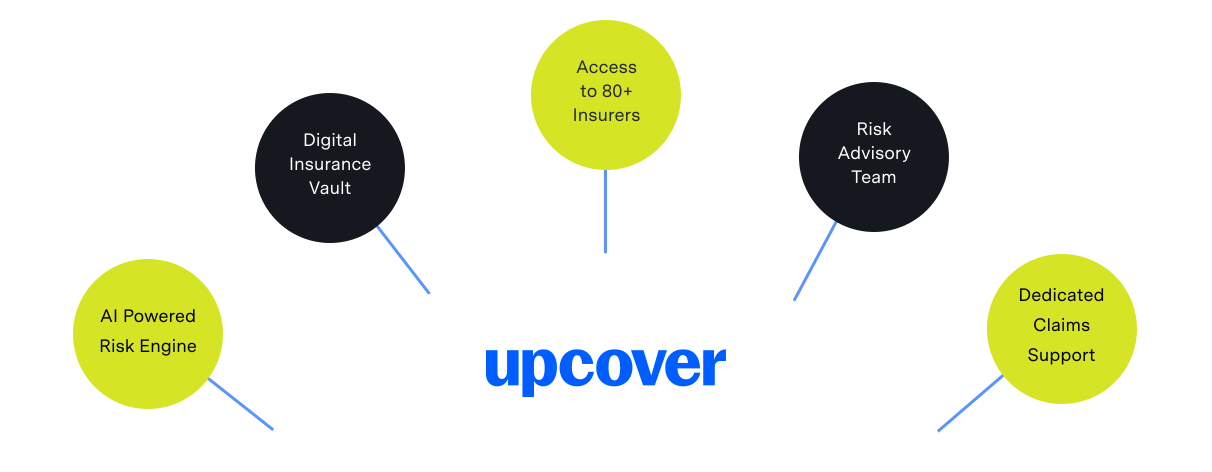
We are digitising commercial insurance and risk management for small, mid-market and technology businesses. We work with a global network of underwriters, challenging legacy brokers and delivering market leading coverage to our customers.