Select how you’d like to proceed with your insurance needs.
Schedule a Call Today
Talk to a real insurance expert on your time.
BOOK A CONSULTATION
WHAT’S IN THIS STEP
15-minutes consultation with licensed advisors
Perfect if you’re unsure about coverage needs
Get personalised recommendations
Make upcover your insurance broker
Already have coverage? Let’s simplify your service
CHANGE BROKER
WHAT’S IN THIS STEP
Keep your current carriers & policies
Simple digital authorisation process
Seamless transition to better service
Insurance Basics
Startup founder insurance: D&O for Australian founders
July 28, 2026
10 Mins Read
"Startup founder insurance" is not a single product category. It usually refers to directors and officers (D&O) insurance or management liability cover. These products may respond to certain claims against founders, directors and officers arising from management decisions.
The distinction that matters: a Pty Ltd structure limits shareholder exposure to company debts. It does not remove the personal duties that attach to anyone who is appointed as a director or who acts in a director-like capacity. If you are both a founder and an appointed director, director duties apply to you personally. A person may also be treated as a director in some circumstances even without formal appointment (sometimes called a de facto or shadow director). upcover arranges insurance options for Australian startup and technology businesses including D&O and management liability.
What personal duties do startup founders have as directors?
Directors of Australian companies owe personal duties under the Corporations Act. These duties apply to the individual, not to the company. Alleged or established breaches can result in investigations, proceedings, penalties or compensation claims against the individual, depending on the circumstances.
Care and diligence (s180). Directors must exercise their powers with the degree of care and diligence a reasonable person would in the same position. Allegations may arise where a director approves a major commitment without adequate information, fails to monitor the company's finances, or disregards a known material risk.
Good faith (s181). Directors must act in good faith in the best interests of the company and for a proper purpose. Allegations can arise from conflicts of interest, related-party transactions, or decisions that appear to benefit one founder at the expense of the company or its shareholders.
Preventing insolvent trading (s588G). Directors must not allow the company to incur debts when there are reasonable grounds to suspect the company cannot pay them as they fall due. This becomes especially relevant where cash flow is deteriorating or the company may be unable to meet debts when due.
Directors also have obligations concerning use of position and information, conflicts, financial records and company compliance. This article covers the duties most relevant to D&O insurance, not the full statutory list.
Where claims can come from. Allegations against founders can come from shareholders (disputes over equity, dilution, disclosure or valuation), regulators (ASIC investigations into conduct, compliance or reporting), creditors (claims related to insolvent trading or unpaid debts), co-founders (disagreements over direction, equity or decision-making), and employees (wrongful termination or discrimination, though these may sit under EPL or management liability rather than D&O).
D&O is not a substitute for legal, tax, insolvency or governance advice and does not cover every personal liability a founder may face.
What may D&O insurance cover?
D&O insurance may respond to covered claims against insured directors and officers arising from alleged wrongful management acts. Defence costs may be included where provided by the wording, subject to policy terms.
How the cover is typically structured (structures vary by insurer):
Individual cover (sometimes called Side A). Where the company cannot or does not indemnify a director, D&O may respond to protect the individual. This layer can be particularly relevant when the company is in financial difficulty or the indemnity is legally void.
Company reimbursement (sometimes called Side B). Where the company does indemnify its directors (as many startup constitutions allow), D&O may reimburse the company for the costs of that indemnification.
Entity cover (sometimes called Side C). Some policies extend cover to certain claims made directly against the company for management-related allegations. The scope of entity cover varies and may be restricted to specified claims or policy sections. It is not included in every D&O policy.
Defence costs may sit within the policy limit, depending on the wording. That can reduce the amount remaining for other covered claims. Check whether defence costs are within or in addition to the limit.
D&O is a claims-made product. The policy active when the claim is first made and notified may be the relevant policy. The underlying conduct must also fall within the retroactive date and remaining terms. Known circumstances, prior claims, continuity and notification requirements also matter.
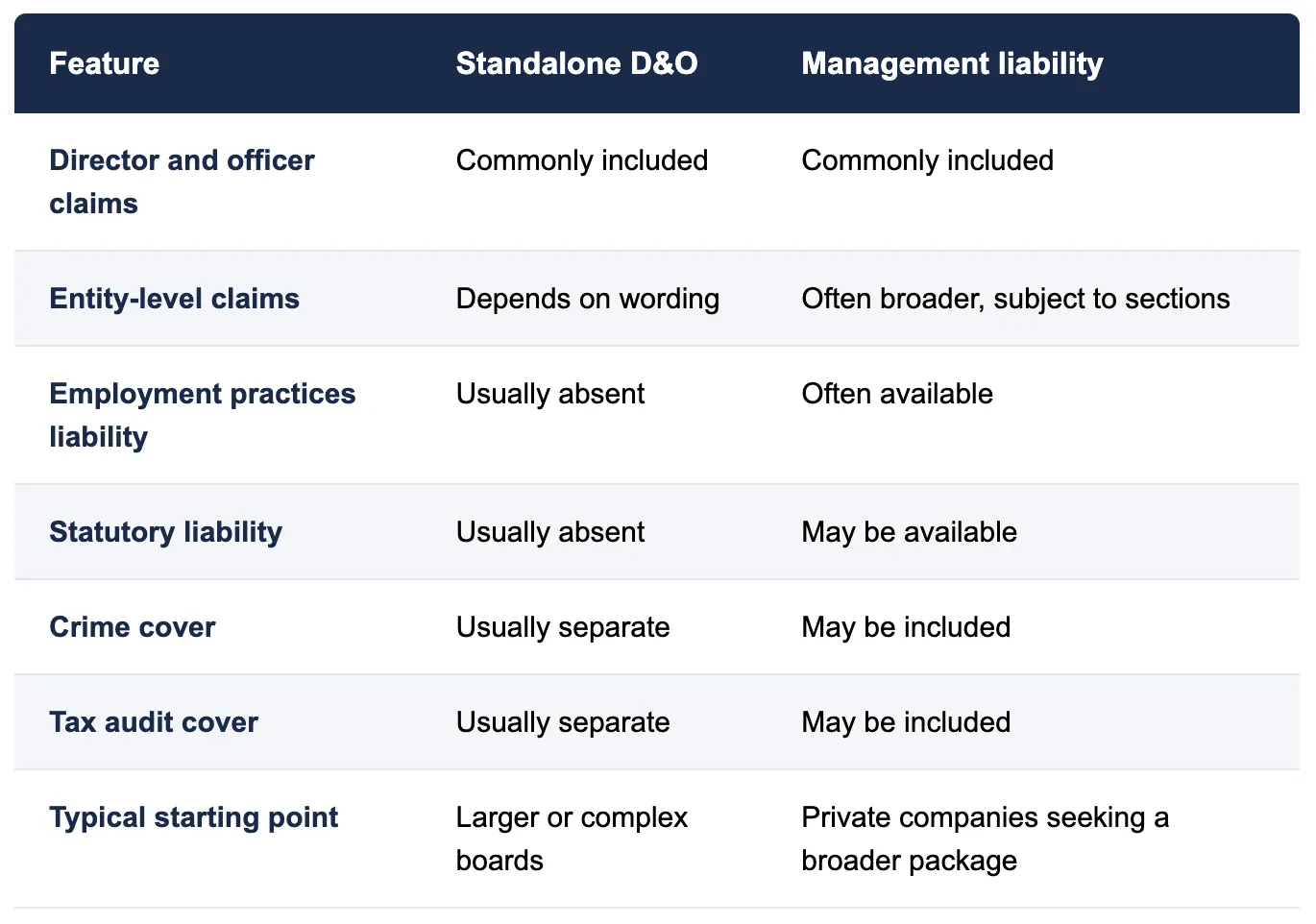
D&O or management liability: what is the difference?
This is a product-structure question that affects what a startup actually buys.
Many Australian startups arrange management liability because it covers the broader set of exposures (D&O, EPL, statutory liability, crime, tax audit) in one policy. Standalone D&O is more common where the board structure or governance requirements are complex enough to warrant dedicated director protection.
The choice depends on the company's structure, board, shareholder base and the types of allegations it may face. Check what sections are included before assuming one product covers everything.
What D&O generally does not cover
Founders should understand where D&O stops. Common exclusions in D&O wordings include:
Deliberate, dishonest or criminal conduct. May be excluded, with the point at which the exclusion applies depending on the wording. Some policies advance defence costs until conduct is established; others apply the exclusion differently.
Prior and known matters. Claims or circumstances the insured knew about before the policy started, or matters already notified under a previous policy.
Bodily injury and property damage. Generally addressed by other policies such as public liability, although limited carve-backs may exist in some wordings.
Product and technology claims. If a client alleges your software failed or your product caused loss, that is usually assessed under Tech PI, PI or products liability, depending on the allegation. Not D&O.
Employment practices claims. Allegations of unfair dismissal, harassment, discrimination or adverse action may sit under EPL or the employment-practices section of a management liability policy, not standalone D&O.
Professional services errors. A client claiming your advice was wrong is a PI or Tech PI matter. D&O responds to management decisions, not professional-service delivery.
Insolvency-related exclusions. Some wordings restrict or exclude cover for insolvent-trading claims or claims arising from voluntary administration. Some policies may still provide certain defence-cost or individual protection, while others impose broader insolvency restrictions. Check the wording carefully.
Insured-vs-insured exclusions. Some D&O policies restrict or exclude claims by one insured person against another. This can be relevant for co-founder disputes. Check whether the wording includes or modifies this exclusion.
One event can generate multiple allegations. A data breach may be a cyber claim directly. But directors may face a separate oversight allegation under D&O if inadequate governance or controls are claimed.
When should a startup assess D&O?
D&O is not relevant for every startup from day one. It becomes relevant when governance formalises and personal director exposure becomes material.
When appointing external directors. A new insured person assumes governance duties. Incoming directors may ask about D&O before accepting an appointment.
When raising institutional capital. Investors may review governance and insurance in due diligence. Some term sheets include insurance provisions. Whether and when D&O is required depends on the investor and the transaction. Board observers are not automatically directors, although their actual role and influence should be reviewed separately.
When the shareholder base grows. More shareholders can mean more disclosure obligations and more potential sources of allegations about management decisions.
In regulated sectors. Startups in fintech, healthtech or other regulated verticals may face additional licensing, reporting or regulatory obligations that increase leadership scrutiny.
Before M&A, restructuring or winding down. Leadership decisions during these periods are high-stakes and can be challenged after the event. Run-off cover or an extended reporting arrangement may be relevant. The terminology and scope vary between insurers.
During financial difficulty. Insolvent-trading duties become acute when the company's cash position deteriorates. Directors should seek qualified advice and assess whether D&O responds to the relevant exposures.
D&O does not have a standard package price. Premiums vary based on the company's specific circumstances, and the numbers below are general market indicators, not quotes. Your actual premium will depend on your business, board, financials and insurer.
As a general guide, D&O premiums for Australian startups typically fall in these ranges:
Early-stage startup with a small board, limited funding and straightforward governance: from around $150 to $250 per month. This reflects a lower-complexity risk profile with standard limits.
Seed to Series A with external directors, institutional investors and growing shareholder obligations: commonly $250 to $400 per month. External board members, formal governance and investor reporting increase the underwriting factors.
Series B+ or complex governance with multiple funding rounds, a larger board, regulated activities or international operations: $400 to $500+ per month, and potentially above that for complex structures, higher limits or regulated sectors.
The main drivers that move the price: funding raised and financial position, board composition and number of directors, sector (regulated industries attract higher premiums), governance complexity and shareholder structure, claims history and known circumstances, selected limit and excess, and whether the policy includes broader management liability sections (EPL, statutory liability, crime, tax audit) beyond standalone D&O.
These are general market indicators. Your actual premium will reflect your company's specific risk profile. For the detailed breakdown by factor, see D&O insurance cost in Australia.
Which cover may respond to common founder scenarios
Not every claim against a founder is a D&O claim. This table maps common startup allegations to the cover type that may respond.
upcover Pty Ltd (ABN 17 628 197 437) is a Corporate Authorised Representative (CAR 1299211) of Experience Insurance Services Pty Ltd (ABN 41 657 596 506, AFSL 539078).
Frequently asked questions
What is startup founder insurance?
It is not a single product. "Startup founder insurance" usually refers to D&O or management liability cover that may respond to claims against founders, directors and officers arising from management decisions. "Founder liability insurance" is the same concept under a different search term.
Do startup founders need D&O insurance?
D&O becomes relevant when governance formalises: appointing external directors, raising institutional capital, expanding the shareholder base, entering regulated sectors, or approaching M&A. Not every startup needs D&O from day one.
Does a Pty Ltd protect founders from personal liability?
A Pty Ltd limits shareholder liability for company debts. It does not remove personal director duties under the Corporations Act. Alleged or established breaches can result in personal proceedings or liabilities, depending on the circumstances.
What does D&O cover for a startup?
D&O may respond to certain covered claims alleging wrongful management acts, including defence costs where provided by the wording. Cover may protect directors individually, reimburse the company for indemnification costs, and in some policies extend to entity-level claims. Structures vary by insurer.
Is D&O required before Series A?
Some term sheets include insurance provisions, and incoming board members may want cover in place before accepting an appointment. Whether and when D&O is required depends on the investor and the transaction. There is no universal Series A rule.
How much does D&O cost for a startup?
There is no standard price. As a general guide, early-stage startups may pay from around $150 to $250 per month, seed to Series A companies commonly $250 to $400, and later-stage or complex-governance startups $400 to $500+ or more. These are general market indicators, not quotes. Your actual premium depends on your board, funding, financials, sector and claims history. See D&O insurance cost in Australia for the full breakdown.
What is the difference between D&O and management liability?
Management liability is a broader product that may include D&O alongside EPL, statutory liability, tax audit cover and crime cover. Standalone D&O covers only director and officer claims. The choice depends on the company's structure and the types of exposures it faces. See the comparison table above.
Can a director be personally sued in Australia?
Yes. Directors owe personal duties under the Corporations Act, and claims can be brought against them individually. That does not mean every unsuccessful business decision creates personal liability. The outcome depends on the specific duty, the conduct and the circumstances.
This article is general information, not legal, governance, insolvency or compliance advice. All insurance arranged through upcover is subject to the relevant policy wording, PDS, terms, conditions, limits and exclusions. upcover Pty Ltd ABN 17 628 197 437, CAR 1299211 of Experience Insurance Services Pty Ltd ABN 41 657 596 506, AFSL 539078.
To get public liability insurance online, request a quote, answer questions about your business, check the policy, then get your certificate of currency.
Social engineering explained: phishing, invoice scams, vishing and smishing, warning signs, prevention steps and how cyber or crime insurance may respond.
We are digitising commercial insurance and risk management for small, mid-market and technology businesses. We work with a global network of underwriters, challenging legacy brokers and delivering market leading coverage to our customers.
The information contained on this website is general advice only and has been prepared without taking into account your individual needs, objectives and financial situation. It should not be relied upon as advice. All insurance products are subject to the terms, conditions, limits and exclusions contained in the relevant policy wording and Product Disclosure Statement. Before deciding whether a particular insurance product is right for you, please consider your personal circumstances and read the relevant Product Disclosure Statement, Target Market Determination, Policy Wording, and Financial Services Guide.

.svg)



.svg)
.svg)
.svg)
%201.svg)


.svg)




.svg)


