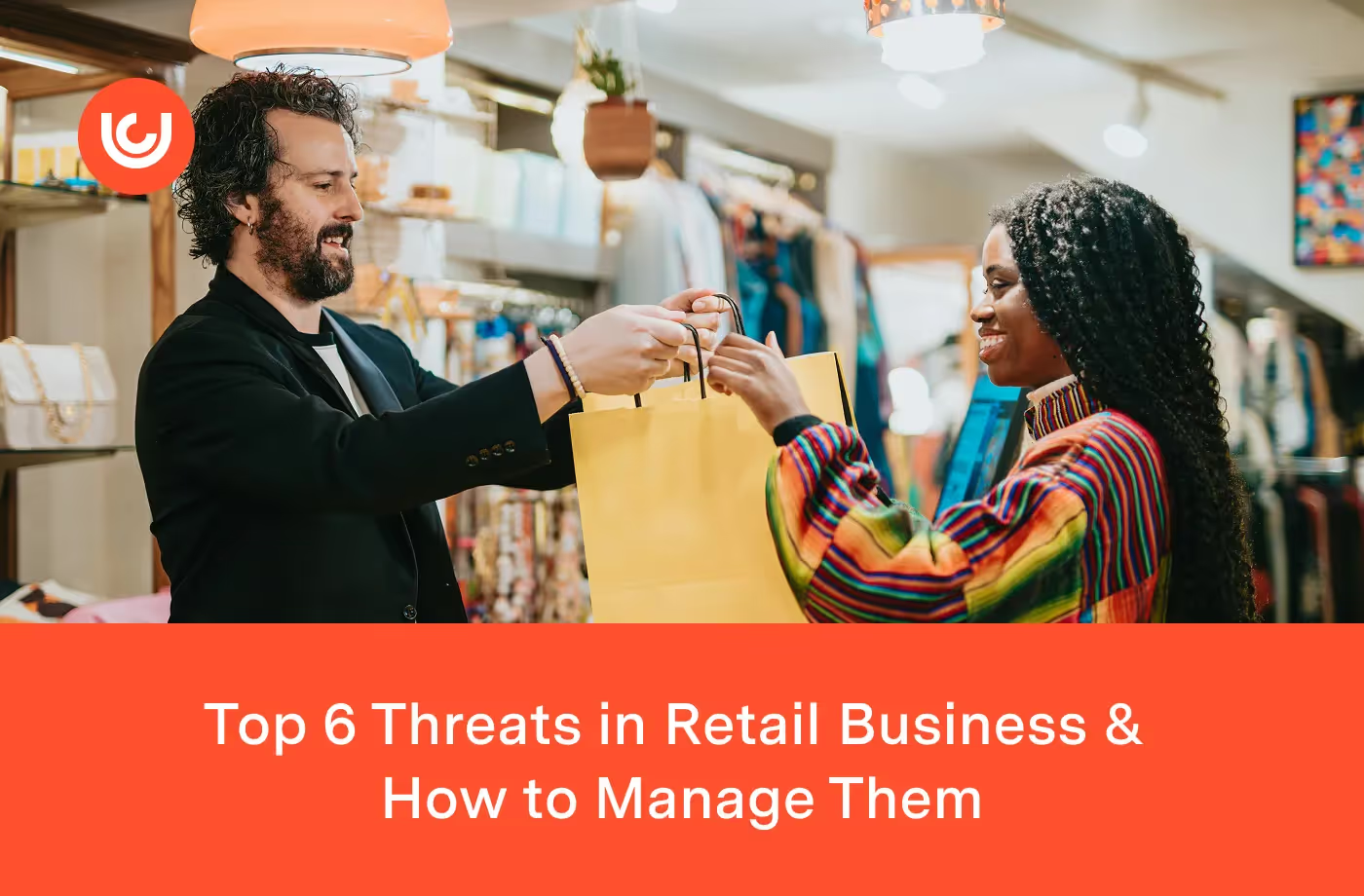
Running a retail business in Australia takes more than good product selection and a welcoming shopfront. Every day you trade, you are also managing a set of risks that can affect your revenue, your customers, and your ability to keep the doors open.
Understanding the risks in the retail industry is the first step toward managing them. This guide covers the most significant threats facing Australian retailers today, practical steps to reduce your exposure, and the types of insurance cover that may help protect your business when things go wrong.
Risks in the Retail Industry: Threats, Cyber Security and How to Manage Them
1. Cyber Security Threats in Retail
Retail is one of the most targeted industries for cyber attacks in Australia. Retailers process high volumes of customer transactions, hold payment card data, manage loyalty programme accounts, and operate multiple connected systems such as point-of-sale terminals, ecommerce platforms, and warehouse management software. Each of these creates a potential vulnerability.
Cyber security risk in retail is not limited to large chains. Small and mid-sized retailers are increasingly targeted precisely because they are less likely to have dedicated IT security resources in place.
Common cyber security threats in retail
- Payment card data theft: attackers target point-of-sale systems and ecommerce checkout pages to capture credit and debit card details.
- Ransomware: malicious software encrypts your business systems and demands payment for restoration. For a retailer, this can result in days of trading downtime and supply chain disruption.
- Phishing and social engineering: staff members are manipulated into disclosing login credentials or authorising fraudulent transactions.
- Third-party vendor breaches: if a supplier or software provider you rely on is compromised, your customer data may be exposed even without a direct attack on your own systems.
- Ecommerce fraud: fake accounts, stolen card transactions, and refund fraud targeting online retail operations.
The impact of cyber threats on consumers and your business
When a retailer suffers a data breach, the consequences reach further than most business owners anticipate. The effects land on customers first, then on the business, and then on both through the regulatory system.
What consumers face
Customers whose payment card details are stolen through a compromised point-of-sale system or ecommerce checkout can have fraudulent transactions hit their accounts within hours of the breach. Personal information stored in loyalty programme accounts, including names, email addresses, purchase history, and home addresses, can be sold on dark web marketplaces or used in targeted phishing and identity fraud campaigns. When health or financial data is included, the risk to affected individuals is more serious still.
Trust, once damaged by a breach, is slow to recover. Research consistently shows that a significant proportion of customers affected by a retail data breach reduce their spending with the business responsible, or stop shopping there altogether. For retailers whose revenue model depends on repeat purchase behaviour and loyalty, the long-term revenue impact can outlast the direct incident costs by years.
What the business faces financially
According to IBM's 2024 Cost of a Data Breach Report, the average cost of a data breach in Australia is $4.26 million. For retailers with large customer databases and complex multi-channel operations, costs typically run higher than this average.
Direct costs typically include forensic investigation to determine how the breach occurred and what data was affected, legal fees for managing regulatory obligations and any resulting claims, mandatory notification to each affected customer individually, credit monitoring services for affected individuals, crisis communications and PR management, and business interruption losses while systems are offline or under investigation. Each of these items arrives at the same time, often within days of an incident being detected.
The regulatory reality for Australian retailers
Retailers with annual turnover above $3 million are covered by the Privacy Act 1988 and the Notifiable Data Breaches scheme. When a breach is likely to cause serious harm to any affected individual, the business must notify both the OAIC and those individuals. Failure to notify carries significant penalties.
The regulatory stakes have increased recently. The Privacy and Other Legislation Amendment Act 2024 raised maximum penalties for serious privacy breaches to $50 million for companies. From June 2025, a statutory tort for serious privacy invasions came into effect, meaning affected customers can now sue the retail business directly, not just lodge a complaint with the OAIC. A data breach that previously meant regulatory scrutiny now also carries the potential for direct civil litigation from affected customers at the same time.
Retailers below the $3 million turnover threshold are not covered by the Privacy Act but are not protected from consequences. Customers can still pursue common law remedies, and reputational damage from a breach is not scaled to business size.
How to reduce cyber security risk in retail
- Use a PCI-DSS compliant payment gateway and avoid storing raw card data on your own systems.
- Enable multi-factor authentication on all business accounts, including email, cloud storage, and your ecommerce platform.
- Apply software updates and security patches to your POS systems, antivirus tools, and operating systems regularly.
- Train your team to recognise phishing attempts as part of standard onboarding and ongoing staff development.
- Run vulnerability assessments before peak trading periods such as Christmas and end of financial year.
Cyber Insurance for Retail Businesses
Cyber insurance is built to help protect your retail business from risks like hacking, phishing, extortion, scams and data theft. A policy that may include cover for crisis management, legal fees, investigations, ransom and recovery costs, helping you get back on your feet quickly. upcover arranges cyber and technology cover that may help reduce out-of-pocket costs for disputes and legal issues, so you can keep running your business without risking your savings
2. Theft, Shoplifting and Physical Security Risks
Retail theft is one of the most persistent risks in the retail industry. External shoplifting and internal employee theft collectively contribute to what the industry calls shrinkage: the gap between recorded stock and actual stock on hand. Shrinkage costs Australian retailers significant sums each year and can quietly erode profitability even when trading conditions look healthy.
Retail security threats have also grown more sophisticated. Organised groups use coordinated shoplifting, receipt fraud at self-checkout terminals, and returns scams involving counterfeit receipts or goods stolen elsewhere. These are not isolated incidents and require structured responses.
Steps to reduce theft and shrinkage
- Install CCTV throughout the store. Visible cameras act as a deterrent as well as providing evidence following an incident.
- Apply security tags and electronic article surveillance on high-value merchandise.
- Train staff on loss prevention practices, including how to approach suspected shoplifters safely and within the law.
- Separate duties for cash handling, stock receiving, and inventory counting to reduce internal theft opportunities.
- Conduct regular stock counts and investigate discrepancies promptly.
Physical damage to your premises and stock
Beyond theft, retail premises face risks from fire, storm damage, water leaks, vandalism, and break-ins. These events can halt trading for days or weeks. A Business Pack Insurance policy arranged through upcover may include cover for building and contents damage, stock loss, glass breakage, and business interruption, helping you recover and resume trading as quickly as possible.
Business Pack Insurance for Retailers
A Business Pack Insurance policy bundles key covers into one small business insurance policy. For retailers, this may include property and contents, theft, business interruption and public liability, depending on the policy. Rather than managing multiple separate policies, a business pack keeps your cover consolidated and straightforward.
3. Public Liability and Customer Injury Risks
Any retail business with customers on its premises carries public liability risk. A customer slips on a recently mopped floor. A product falls from a shelf and causes an injury. A display fixture collapses near a child. These situations occur in retail environments across Australia every year, and when they do, the business owner is likely to face a compensation claim.
This is one of the threats in the retail sector that often catches business owners off guard. Liability does not depend on intent. It depends on whether a reasonable duty of care was owed and whether it was breached.
Product liability: a separate but related risk
If your retail business sells physical products, you may also carry liability if those products cause injury or property damage to a customer. This applies even when you did not manufacture the product. A customer who suffers an allergic reaction to a food item, or whose property is damaged by a faulty appliance purchased from your store, may make a claim directly against your business.
Reducing public and product liability risk
- Conduct regular store safety audits covering floors, shelving, lighting, and customer walkways.
- Keep maintenance records and address hazards promptly rather than leaving them for a scheduled review.
- Train staff on incident response procedures so they know how to act immediately following an accident.
- For products you sell, maintain supplier records and batch numbers so you can act quickly if a recall is issued.
Public and Products Liability Insurance for Retailers
Public Liability Insurance and Products Liability Insurance may help protect your retail business if a customer is injured on your premises, property is damaged, or a product you sell causes harm. For retailers, this cover is often a lease requirement and a practical safeguard against the cost of compensation claims and legal defence.
4. Supply Chain Disruptions
The retail industry's dependence on interconnected supply chains became particularly visible in recent years, and the conditions that caused those disruptions have not entirely resolved. For Australian retailers, supply chain risks include:
- Supplier insolvency: a key supplier ceases trading mid-season, leaving you without critical stock.
- Transport delays: international shipping backlogs or domestic freight issues that affect stock availability during peak periods.
- Natural disasters: floods, bushfires, or cyclones affecting suppliers, distribution centres, or your own premises.
- Stock imbalances: overstocking slow-moving lines ties up working capital, while understocking during peak periods results in lost sales and poor customer experience.
Building supply chain resilience
- Diversify your supplier base so that no single supplier is critical for a high-volume product line.
- Hold safety stock for your top-selling products, particularly before known peak periods.
- Include delivery guarantees and clear escalation processes in supplier agreements.
- Review your Business Pack Insurance policy for business interruption coverage, which may include protection for trading losses resulting from events that physically disrupt your operations.
5. Employment and Workplace Risks
Retail has one of the higher rates of workplace injury claims across Australian industries. The physical demands of the role, including stock handling, extended periods of standing, and customer-facing work, create a consistent source of risk for employees. Beyond physical injury, retailers also face employment-related claims including unfair dismissal, workplace harassment, and Modern Award compliance failures.
Key employment risks for retail businesses
- Manual handling injuries: back strains, repetitive strain injuries, and slips are common in retail stockrooms and on the shop floor.
- Unfair dismissal and adverse action claims: these are particularly common in industries with high staff turnover such as retail.
- Award non-compliance: the Retail Industry Award is complex. Errors in applying penalty rates, overtime, and casual loading provisions can result in back-payment obligations and regulatory action.
- Harassment and discrimination claims: retailers with large and diverse workforces need clear written policies and regular staff training to manage this risk.
Practical risk management steps
- Implement a workplace health and safety management system that includes hazard identification, incident reporting, and safe work procedures.
- Provide regular manual handling training, particularly for staff who receive stock deliveries or work in the stockroom.
- Engage a payroll specialist to audit Award compliance at least annually.
- Maintain thorough HR records including written contracts, performance notes, and disciplinary documentation.
6. Economic Pressures and Competitive Risk
Australian retailers are operating in a high-cost environment. Rising rents, energy prices, and wage growth are compressing margins at the same time that consumers are becoming more price-sensitive. The ongoing shift toward online shopping and the growth of international ecommerce platforms add a structural competitive layer to these pressures.
While economic risk cannot be insured against directly, sound financial management significantly reduces vulnerability to downturns.
Strategies for managing economic and competitive risk
- Review your cost structure regularly. Identify fixed costs that could be made variable and suppliers where renegotiation is possible.
- Invest in customer retention. Retaining existing customers is almost always less costly than acquiring new ones.
- Diversify revenue streams. A basic online presence or click-and-collect capability provides a buffer during periods of reduced foot traffic.
- Use sales data to improve stock planning. Reducing dead stock improves cash flow and reduces the risk of having to discount heavily at the end of the season.
How the Right Insurance Supports Risk Management in Retail
The following three types of insurance cover are most relevant to Australian retail businesses.
- Cyber and Technology Insurance: Cyber insurance is built to help protect your retail business from risks like hacking, phishing, extortion, scams and data theft. A policy that may include cover for crisis management, legal fees, investigations, ransom and recovery costs, helping you get back on your feet quickly. upcover arranges cyber and technology cover that may help reduce out-of-pocket costs for disputes and legal issues, so you can keep running your business without risking your savings.
- Business Pack Insurance: A Business Pack Insurance policy bundles key covers into one small business insurance policy. For retailers, this may include property and contents, theft, business interruption and public liability, depending on the policy. Rather than managing multiple separate policies, a business pack keeps your cover consolidated and straightforward.
- Public and Products Liability Insurance: Public & Product Liability Insurance may help protect your retail business if a customer is injured on your premises, property is damaged, or a product you sell causes harm. For retailers, this cover is often a lease requirement and a practical safeguard against the cost of compensation claims and legal defence.
upcover arranges insurance with a network of over 40 underwriters, which means we can find cover suited to your specific retail setup, whether you operate a single-location store, multiple sites, or an ecommerce business. Get an instant quote in minutes.
Frequently Asked Questions
What are the biggest risks in the retail industry?
The biggest risks in the retail industry include cyber security threats such as data breaches and ransomware, theft and shoplifting, public liability from customer injuries on premises, supply chain disruptions, employment-related claims, and economic pressures including rising costs and changing consumer behaviour. Each of these can result in financial loss, legal costs, or reputational damage if not managed proactively.
How do cyber security threats in retail affect consumers?
When a retail business suffers a data breach or cyber attack, consumers can face identity theft, unauthorised transactions on their payment cards, and exposure of their personal information. Beyond the immediate impact, consumer trust in the affected business is often significantly damaged. Australian retailers are also subject to mandatory data breach notification laws under the Privacy Act 1988, meaning affected customers must be informed when their personal data is compromised.
What is risk management in the retail industry?
Risk management in the retail industry is the process of identifying the threats your business faces, assessing their likelihood and potential impact, and implementing measures to reduce or manage them. This includes operational controls such as security systems and staff training, financial controls such as cash flow management and supplier diversification, and risk transfer mechanisms such as insurance cover arranged through a licensed broker.
Do retail businesses need Public Liability Insurance?
Most retail businesses should seriously consider Public Liability Insurance, and many are required to hold it by their landlords or shopping centre operators as a lease condition. If a customer or member of the public is injured on your premises, or if a product you sell causes injury or property damage to a customer, a Public and Products Liability Insurance policy may include cover for associated legal costs and compensation claims.
What does a Business Pack Insurance policy cover for retailers?
A Business Pack Insurance policy arranged through upcover may include cover for building and contents damage, theft and burglary, glass breakage, fire and storm damage, and business interruption covering income loss while your store is unable to trade following an insured event. Specific terms, conditions, sub-limits, and exclusions will depend on the policy wording and your insurer.
Does Cyber Insurance cover retail businesses that only trade in-store?
Yes. Cyber threats are not limited to ecommerce businesses. Bricks-and-mortar retailers that use point-of-sale systems, accept card payments, store customer data, or use cloud-based inventory or accounting software all face cyber security risk. A Cyber Insurance policy arranged through upcover may include cover for incidents affecting in-store systems, not only online operations.
What are the most common retail security threats?
The most common retail security threats include shoplifting by individuals and organised groups, internal employee theft, payment card fraud at point-of-sale, cyber attacks targeting customer data and payment systems, and physical incidents such as break-ins and vandalism. Effective risk management combines physical security measures, staff training, technology controls, and appropriate insurance cover.
The information in this article is general in nature and has been prepared without taking into account your individual needs, objectives or financial situation. It should not be relied upon as personal advice. All insurance products arranged through upcover are subject to the terms, conditions, limits and exclusions contained in the relevant policy wording and Product Disclosure Statement. Before deciding whether a particular insurance product is right for you, please read the relevant PDS and consider your personal circumstances.

.svg)



.svg)
.svg)
.svg)
%201.svg)


.svg)




.svg)


