Public liability claims often begin with an everyday incident: a customer falls, a contractor damages property, or a member of the public is injured near a worksite. These public liability insurance claims examples show how common Australian business incidents may develop, what costs can arise, and what to do next.
The scenarios below are illustrative only. They are not real upcover client claims. All claims are subject to policy terms, conditions and exclusions.
upcover arranges public and products liability insurance for eligible Australian businesses (AFSL 539078). For the full product overview, see what is public liability insurance.
Public liability claim scenarios at a glance
| Scenario |
Industry |
Incident |
Cover to assess |
Evidence to preserve |
| Customer slip and fall |
Hospitality or retail |
Customer slips on wet floor, fractures wrist |
Public liability |
CCTV, cleaning logs, photos |
| Property damage at client's site |
Trades |
Electrician drops tool, gouges hardwood floor |
Public liability |
Photos, work order, repair quote |
| Third-party injury from worksite hazard |
Warehousing |
Delivery driver trips over stock boxes |
Public liability |
Incident report, layout photos, witness details |
| Off-site damage to neighbour's property |
Landscaping |
Falling branch destroys neighbour's greenhouse |
Public liability |
Site photos, work scope, weather records |
| Imported product causes injury |
E-commerce |
Faulty charger burns customer's hand |
Products liability section |
Product, batch and supplier records |
| Food-related illness |
Hospitality |
Customer alleges food poisoning |
Products liability section |
Food-safety records, supplier invoices |
| Retail display injures shopper |
Retail |
Unsecured display tips, strikes customer |
Public liability |
CCTV, display setup records, incident report |
Swipe left or right to see the full table.
Recognise a similar exposure? Check whether your premises, work activities, subcontractors and products are accurately declared under your current liability cover.
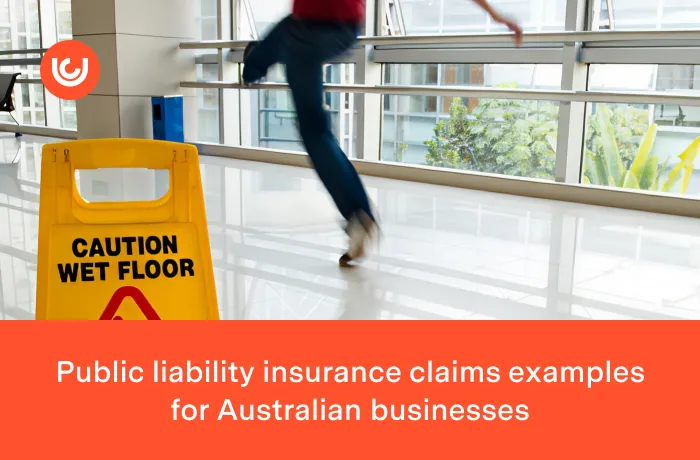
Scenario 1: customer slip and fall at a café
A customer slips near a drinks station after liquid is spilled. There is no wet-floor sign. The customer fractures a wrist and alleges the business failed to clean or mark the area promptly.
Possible financial impact: medical and rehabilitation expenses claimed by the customer, lost-income allegations, legal defence costs, expert reports, and compensation where liability is established.
Cover to assess: public liability, for third-party injury arising from how the premises were managed.
What may happen next: the insurer may examine cleaning procedures, signage, CCTV footage and causation before deciding whether to defend, negotiate or resolve the claim.
Key lesson: the allegation turns on what the business did or did not do to manage the hazard. Cleaning logs, CCTV and incident records all matter.
Scenario 2: tradesperson damages a client's property
An electrician working at a residential property drops a heavy tool onto a polished hardwood floor, causing deep gouges that require full board replacement. The client seeks the cost of repairing or replacing the damaged flooring.
Possible financial impact: repair or replacement costs, legal defence if the amount is disputed, expert assessment, and the policy excess.
Cover to assess: public liability, for property damage caused by the business's activities at a client's site.
What may happen next: the insurer may review the work order, photos of the damage, repair quotes and any prior communication about protecting surfaces.
Key lesson: property damage at client premises is a common type of exposure for businesses working at third-party sites. Photographs at the time and prompt notification matter more than a verbal apology.
Scenario 3: delivery driver injured by a worksite hazard
A delivery driver arrives at a warehouse and trips over stock boxes left in a narrow walkway by staff. The driver injures an ankle and alleges the business created an unsafe environment for visitors.
Possible financial impact: the driver's medical costs, their employer's claim for lost productivity, legal defence, and investigation expenses.
Cover to assess: public liability, for third-party injury on the business's premises.
What may happen next: the insurer may investigate the premises layout, housekeeping procedures, whether the walkway was obstructed and what warnings were in place.
Key lesson: the injured person does not need to be a customer. Delivery drivers, contractors and visitors may allege that the business's premises or activities caused their injury.
Scenario 4: off-site damage to a neighbour's property
A landscaping contractor is pruning a tree at a residential property. A large branch falls outside the work area and destroys the neighbour's greenhouse and fencing.
Possible financial impact: repair and replacement costs for the greenhouse, fencing and contents, defence costs if liability is disputed, and the policy excess.
Cover to assess: public liability, for property damage caused by the business's activities at a worksite.
What may happen next: the insurer may review site photos, the scope of work, exclusion-zone arrangements, weather conditions, subcontractor details and repair quotations.
Key lesson: the damage does not need to happen on the business's own premises. Work at a client's site can damage neighbouring property, and the claim may name the contractor directly.
Scenario 5: imported product causes injury after sale
An e-commerce retailer sells a phone charger imported from overseas. A customer's unit overheats, causes a small fire and burns the customer's hand, requiring treatment by a medical practitioner.
Possible financial impact: the customer's medical costs, property damage to the benchtop or surrounding area, defence costs, expert testing of the product, and the policy excess.
Cover to assess: products liability section, for injury and property damage caused by a product the business supplied. For how products liability differs from public liability, see public liability vs products liability insurance.
What may happen next: the insurer may investigate the product, its source, batch records and whether the business had quality or safety checks in place. The business should stop further sales of the batch where appropriate and preserve the product, stock and packaging.
Key lesson: importers, distributors and sellers can be named in product claims. If the injury meets the mandatory-reporting threshold under Australian product-safety law, the supplier must submit a mandatory report to the ACCC within two days of becoming aware.
Scenario 6: food-related illness allegation
A café customer alleges food poisoning after eating a takeaway meal. The customer reports the matter to the relevant food authority and demands reimbursement for medical costs and lost income.
Possible financial impact: the customer's medical and lost-income claims, investigation and defence costs, and reputational management. If multiple customers are affected, the exposure can multiply.
Cover to assess: the products liability section of a combined policy, because food and beverages are treated as products.
What may happen next: the insurer may review food-safety records, supplier invoices, temperature logs and preparation procedures. The food-authority investigation runs separately from the insurance claim.
Key lesson: food and beverages are products. A café, restaurant, food truck or market vendor faces products liability exposure alongside its premises-based public liability risk.
Scenario 7: retail display injures a shopper
A freestanding promotional display in a retail shop tips over and strikes a shopper, causing a head injury that requires hospital treatment.
Possible financial impact: the customer's medical and rehabilitation costs, lost-income allegations, legal defence, expert reports, and any compensation where liability is established.
Cover to assess: public liability, for third-party injury on the business's premises.
What may happen next: the insurer may investigate the display design, securing method, maintenance records and CCTV footage.
Key lesson: if the injury is serious, the business should check whether it is a notifiable incident under its state or territory work health and safety (WHS) laws. Businesses that are PCBUs may be required to notify the relevant WHS regulator where the incident involves a workplace death, serious injury or illness, or a dangerous incident, including those affecting members of the public. The incident site may need to be preserved, except where action is needed to assist the injured person or make the area safe.
What commonly triggers public liability claims in Australia?
Premises and visitors. Slips, trips and falls; unstable displays or shelving; blocked walkways; falling stock or signage.
Work at client sites. Accidental property damage during a job; damage to neighbouring property; hazards created during loading and unloading; subcontractor acts on the business's behalf.
Products. Food or beverage illness; electrical or mechanical product injury; completed installation failure; product supplied by the business that harms a third party after the sale.
What should a business do immediately after a public liability incident?
- Protect life and arrange urgent assistance. Call 000 where there is an immediate danger or serious injury.
- Make the area safe without destroying relevant evidence.
- Note the exact date and time the business first became aware of the incident.
- Record what happened, where it happened and who was involved.
- Photograph the site, product and damage. Preserve CCTV footage before it is overwritten.
- Obtain names and contact details for witnesses and any staff present.
- Preserve cleaning logs, maintenance schedules, product records, work orders and correspondence.
- Notify the insurer or broker promptly where the incident may lead to a claim or where the policy requires notification.
- Do not admit liability or promise to pay without insurer guidance.
- Forward any letter of demand to the insurer promptly.
This is general information, not legal advice.
Which authorities may need to be notified after a public liability incident?
The authority notification and the insurance claim are separate processes.
| Situation |
Who to consider notifying |
Timing guidance |
| Immediate danger, serious injury or crime |
Emergency services (000) |
Immediately |
| Serious work-related injury, illness, death or dangerous incident |
Relevant state or territory WHS regulator |
Immediately, where legally notifiable |
| Product-linked death, serious injury or serious illness meeting the mandatory threshold |
ACCC mandatory product-safety reporting |
Within two days of becoming aware |
| Voluntary product recall |
ACCC product-safety team |
Within two days of taking the recall action |
| Food-safety incident |
Relevant state, territory or local food authority |
Per applicable food-safety requirements |
| Theft, malicious damage or suspected crime |
Police |
Promptly |
| Liability incident likely to lead to a claim |
Insurer or broker |
Promptly, per the policy |
| Contract or lease requires incident notice |
Principal, landlord or market organiser |
Per the contract |
Swipe left or right to see the full table.
Safe Work Australia is the national policy body and is not itself a regulator. Contact the WHS authority in the relevant state or territory. Not every minor incident requires a government report; the table above applies where the incident meets the relevant threshold.
What happens after you notify the insurer?
Once the insurer or broker receives the notification, the process generally follows these steps.
Step 1: The claim is registered. The insurer records the incident or claim and issues a reference number. Keep this number. Every later call, email and document should quote it.
Step 2: The insurer requests evidence. This may include the incident report, photographs, witness details and any correspondence with the claimant. Providing complete evidence early can reduce back-and-forth later.
Step 3: The insurer investigates. The insurer assesses two questions: whether the business is legally liable, and whether the policy responds to the claim. These are separate assessments. A business can be liable for something the policy does not cover.
Step 4: Experts may be appointed. Lawyers, assessors or specialist investigators may be brought in where the claim is complex or disputed. The insurer generally manages these appointments.
Step 5: The claim is resolved. Depending on the circumstances, the claim may be defended, negotiated or settled. The insurer typically leads this decision under the policy's conduct-of-claims provisions.
Step 6: Keep the insurer updated. New information, further correspondence from the claimant or changes in the situation should be passed on promptly. Late or incomplete updates can complicate the claim.
The excess applies to eligible claims.
Why might a public liability claim not be covered?
The event falls outside the policy. The business activity, location or product was not declared. The incident did not occur during an insured period. The third party was actually an employee, which generally sits under workers compensation. The loss is purely financial, with no injury or property damage.
Notification and process. The incident was not notified in accordance with the policy, and the delay prejudiced the investigation or breached an applicable condition. Liability was admitted or payment was made without insurer consent.
Exclusions. Faulty workmanship rectification costs, as opposed to resulting third-party damage, are commonly excluded. Professional advice errors sit under professional indemnity. Damage involving registered motor vehicles may be excluded. Deliberate or criminal acts are excluded. Product recall costs are generally excluded. Known defects, non-disclosure or misrepresentation may affect cover or the insurer's available remedies, depending on the circumstances. The policy limit or aggregate may have been exhausted by another claim.
For the full detail, see what does public liability insurance cover.
What should you have ready before making a public liability claim?
- Policy number and the date the business first became aware
- What happened, when and where
- Claimant name and contact details
- Who was injured or whose property was damaged
- Whether urgent assistance was provided
- Photographs, CCTV and witness details
- Staff statements from those present
- Whether a product was involved, and its supplier, model and batch details
- Whether an employee, contractor or subcontractor was involved
- Any letter of demand, repair quote or medical documentation supplied by the claimant
- Whether any authority has been notified, with reference numbers
- Whether there is a deadline to respond
- Whether anyone has admitted liability or offered payment
How upcover can help
A public liability claim can involve medical costs, property repair, legal defence and investigation expenses, and the exposure is practical and everyday. The best protection is accurate disclosure when arranging cover, good incident management on site, and prompt notification when something goes wrong.
upcover is a digital-first insurance broker helping Australian small businesses get the right insurance without the paperwork or phone queues. upcover arranges public and products liability insurance for eligible Australian businesses, with access to 80+ insurance partners.
- 70,000+ businesses covered across Australia
- 4.9/5 customer rating
- Instant Certificate of Currency on policy confirmation
Have your occupation, turnover, work locations, products, subcontractor use and claims history ready, then explore public and products liability insurance through upcover. Availability and terms depend on insurer acceptance.
upcover Pty Ltd ABN 17 628 197 437 is a Corporate Authorised Representative (CAR 1299211) of Experience Insurance Services Pty Ltd ABN 41 657 596 506, AFSL 539078.
Frequently asked questions
What is a common public liability insurance claim?
Slips, trips and falls are among the most common public liability claims for Australian businesses, followed by property damage caused during work at a client's site. Product-related injuries and food-illness allegations are common under the products liability section.
What should I do if a customer is injured at my premises?
Assist the person, make the area safe, record the facts, preserve evidence including CCTV, and notify your insurer or broker promptly. Do not admit liability without guidance. If the injury is serious, check whether it is a notifiable incident under your state or territory's WHS laws.
Does public liability cover property damage at a client's home?
It may, where the damage was caused by the business's activities and the work and location were declared. Accidental damage to a client's surface, fixture or neighbouring property during a job is a typical claim pattern for trades.
Does public liability cover product injuries?
Injury or damage caused by a product the business supplied is generally assessed under the products liability section rather than public liability. In a combined policy, both sections sit under the same wording. For the comparison, see public liability vs products liability insurance.
Do I need to report a serious injury to a regulator?
It depends on the incident. Businesses that are PCBUs may be required to notify the relevant state or territory WHS regulator where the incident involves a workplace death, serious injury or illness, or a dangerous incident. Product-linked serious injuries meeting the mandatory threshold may also require a report to the ACCC within two days.
Do I need to notify my insurer even if no claim has been made?
Many policies require notification of incidents or circumstances that may lead to a claim. Reporting early where the policy requires it helps preserve the business's position.
Why might a public liability claim not be covered?
Common reasons include undeclared activities or locations, late notification that prejudiced the investigation, employee injury (workers compensation), faulty-workmanship rectification costs as opposed to resulting damage, professional advice errors, deliberate acts, and non-disclosure of known defects or material facts.
The information in this article has been prepared without taking into account your individual needs, objectives or financial situation. It should not be relied upon as personal advice, and it does not constitute legal advice, including in relation to WHS notification obligations, ACCC mandatory reporting, food-safety requirements or incident-response procedures. The scenarios in this article are illustrative only and do not describe real upcover clients. Cover types, inclusions, exclusions and policy structure vary between insurers and policies. All insurance products arranged through upcover are subject to the terms, conditions, limits and exclusions contained in the relevant policy wording and Product Disclosure Statement. Before deciding whether a particular insurance product is right for you, please read the relevant PDS and consider your personal circumstances. upcover Pty Ltd ABN 17 628 197 437 is a Corporate Authorised Representative (CAR 1299211) of Experience Insurance Services Pty Ltd ABN 41 657 596 506, AFSL 539078. upcover arranges insurance products with selected insurers and underwriters and does not compare all general insurers or insurance products available in the market.

.svg)



.svg)
.svg)
.svg)
%201.svg)


.svg)



.svg)


