Select how you’d like to proceed with your insurance needs.
Schedule a Call Today
Talk to a real insurance expert on your time.
BOOK A CONSULTATION
WHAT’S IN THIS STEP
15-minutes consultation with licensed advisors
Perfect if you’re unsure about coverage needs
Get personalised recommendations
Make upcover your insurance broker
Already have coverage? Let’s simplify your service
CHANGE BROKER
WHAT’S IN THIS STEP
Keep your current carriers & policies
Simple digital authorisation process
Seamless transition to better service
Beauty & Personal Care
How to Become a Cosmetic Tattoo Artist in Australia: The 14-Step Checklist
June 16, 2026
10 Mins Read
There is no mandatory national licence for cosmetic tattooing in Australia. But that does not mean you can start treating clients without preparation. You need infection control training, council registration, insurance, and a clear operating setup before you can legally perform any skin penetration procedure.
This checklist covers every requirement you need to meet, organised into four phases: Learn, Register, Set Up, and Operate. Work through each step before you book your first client.
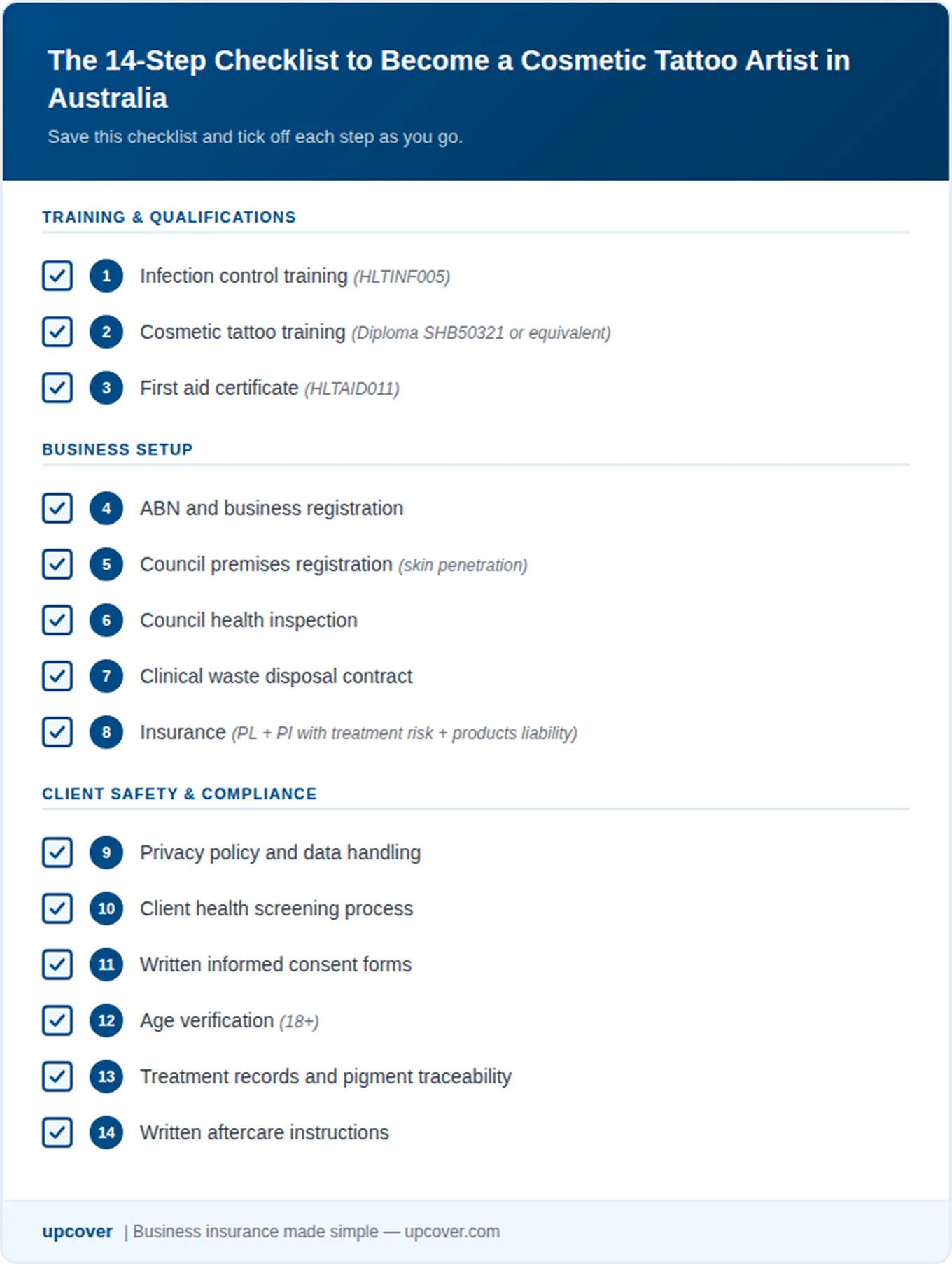
The 14-Step Checklist to Become a Cosmetic Tattoo Artist in Australia:
Infection control training (HLTINF005)
Cosmetic tattoo training (Diploma SHB50321 or equivalent)
First aid certificate (HLTAID011)
ABN and business registration
Council premises registration (skin penetration)
Council health inspection
Clinical waste disposal contract
Insurance (PL + PI with treatment risk + products liability)
Privacy policy and data handling
Client health screening process
Written informed consent forms
Age verification (18+)
Treatment records and pigment traceability
Written aftercare instructions
You do NOT need a body art tattooist licence from NSW Police (SLED) or QLD Office of Fair Trading. Cosmetic tattooing is exempt from body art licensing. It is regulated under public health legislation as a skin penetration procedure, managed by your local council.
Phase 1: Learn
1. Complete infection control training (HLTINF005)
Many councils and state health authorities require infection-control training for skin penetration procedures, and HLTINF005 is a commonly accepted unit. Check the current requirement with your local council or state health department before enrolling.
Many councils and state health authorities require infection-control training for skin penetration procedures, and HLTINF005: Maintain Infection Prevention for Skin Penetration Treatments is a commonly accepted unit. Check the current requirement with your local council or state health department before enrolling. It covers bloodborne viruses, sterilisation procedures, cross-contamination prevention, and clinical waste handling.
A common mistake: some practitioners complete SHBBINF002, which is a beauty industry infection control unit from the hairdressing and beauty services training package. This unit may not be accepted in all states for higher-risk skin penetration procedures. If you plan to work across multiple states, choose HLTINF005 to avoid issues.
How to do it: Search for HLTINF005 providers on training.gov.au. TAFEs and registered training organisations (RTOs) deliver it. It typically takes 1 to 2 days.
2. Get cosmetic tattoo training
There is no single mandatory qualification for cosmetic tattooing in Australia. However, the industry standard is the Diploma of Cosmetic Tattooing (SHB50321). This was the first nationally accredited cosmetic tattoo qualification in Australia, introduced in December 2021. It is delivered by RTOs under the Australian Qualifications Framework.
The diploma covers colour theory, skin anatomy, pigment selection, machine operation, and technique across procedures including eyebrow microblading, lip blush, eyeliner, and scalp micropigmentation. Core units include:
SHBBCOS002: Apply knowledge of colour theory and pigmentology to cosmetic tattooing
SHBBSSC004: Identify the function and structure of skin and hair for cosmetic tattooing
SHBBCOS004 and SHBBCOS005: Provide cosmetic tattooing for eyebrows and lips
Most reputable courses include supervised practice on live models. This hands-on component is where you develop the depth control and symmetry skills that classroom theory cannot teach.
How to do it: Research accredited RTOs that deliver SHB50321. Check independent reviews, not just testimonials on the course website. Confirm the course includes live model practice under supervision.
3. Get a first aid certificate
Most local councils require a current first aid certificate as part of skin penetration premises registration. First aid training is also directly relevant to your work: if a client has a severe allergic reaction to a pigment during a procedure, you need to know how to respond.
The standard unit is HLTAID011: Provide First Aid. It includes CPR and basic anaphylaxis response. The certificate is valid for 3 years, with the CPR component needing annual renewal.
How to do it: Enrol through an RTO, workplace training provider, or organisations like St John Ambulance or the Red Cross. It typically takes 1 day.
Phase 2: Register
4. Register your business
Before you start trading, you need an Australian Business Number (ABN). You can operate as a sole trader or set up a company structure. If your annual turnover will exceed $75,000, you must also register for GST.
If you trade under a name other than your own, you need to register a business name through ASIC.
All cosmetic tattooing is classified as a skin penetration procedure under state public health legislation. You must register your premises with your local council before you start operating. This applies to commercial studios, salon rooms, and home studios.
The specific legislation varies by state:
NSW: Public Health Regulation 2022. You must notify your local council and register as a skin penetration premises.
VIC: Public Health and Wellbeing Act 2008. Council registration is mandatory for all premises performing skin penetration.
QLD: Public Health (Infection Control for Personal Appearance Services) Act 2003. Local council registration is required. Note that QLD also has a separate body art tattooist licence managed by the Office of Fair Trading, but cosmetic tattooing (microblading, lip blush, areola reconstruction) is generally treated as a skin penetration procedure under council health rules, not under the body art licensing regime.
ACT: An infection control licence is required from Access Canberra.
SA, WA, TAS, NT: Council registration is required. No separate cosmetic tattooing licence exists.
Requirements vary by council and state/territory. Always confirm with the local council environmental health team before fitting out a studio or treating clients.
6. Pass a council health inspection
Once you submit your registration, a council environmental health officer will inspect your premises. You must pass this inspection before your registration is approved.
Typical inspection requirements include:
A dedicated treatment area with non-porous, wipeable flooring. Carpet is not permitted.
A hands-free wash basin (elbow-operated, foot pedal, or sensor-activated) that is separate from your equipment cleaning area.
An autoclave or approved sterilisation equipment for reusable instruments.
A sharps disposal container that meets Australian Standards.
Adequate ventilation and lighting in the treatment area.
Single-use items (needles, pigment caps, gloves) stored hygienically and disposed of after each client.
If you operate from a home studio, the treatment area must be physically separated from your residential living spaces. The same hygiene standards apply as for a commercial studio.
How to do it: Review your council's skin penetration guidelines before fitting out your studio. Set up your space to meet the requirements, then contact the council to schedule an inspection.
7. Set up a clinical waste disposal contract
You cannot put used needles, blood-contaminated items, or single-use pigment caps in your regular waste bin. These are classified as clinical waste and must be collected by a licensed clinical waste contractor.
You will need a sharps container that meets Australian Standards (AS 4031 or AS/NZS 4261) and a schedule for regular collection. Keep waste disposal records and destruction certificates as part of your compliance documentation.
How to do it: Contact a licensed clinical waste provider in your area (such as Daniels Health, Stericycle, or a local provider). They will supply containers and arrange a collection schedule.
Phase 3: Protect
8. Arrange insurance
This is where most new cosmetic tattoo artists get caught out. Standard beauty therapy insurance may not cover skin penetration procedures. You need a policy that explicitly lists cosmetic tattooing as a covered activity, with the right extensions.
Public liability insurance may help cover claims if a client is injured at your premises (for example, a slip on a wet floor or an injury from faulty equipment), subject to policy terms.
Professional indemnity insurance with a treatment risk extension may help cover claims arising from the procedure itself. This is the cover that responds if a client alleges that your technique caused harm. Common cosmetic tattoo PI claims include:
Severe allergic reaction to pigment
Pigment migration (colour spreading beyond the treated area)
Keloid scarring from the procedure
Asymmetric results (one eyebrow higher than the other)
Infection from a procedure
Professional indemnity insurance may respond to claims alleging injury arising from professional service delivery, subject to policy terms.
Products liability insurance may help cover claims if a client reacts to a product you supplied, such as pigment, numbing cream, or aftercare products.
upcover arranges professional indemnity, public liability, and products liability insurance for cosmetic tattoo artists across Australia. A Certificate of Currency is issued instantly on policy confirmation. See the cosmetic tattoo artists insurance page for more detail.
9. Set up a privacy policy
You will collect sensitive health information from clients (medical history, skin conditions, medications, pregnancy status). This triggers obligations under the Privacy Act 1988 (Cth) and the Australian Privacy Principles (APPs).
You need a written privacy policy that explains how you collect, store, use, and protect client health data. Keep consent forms and treatment records in a secure location (locked cabinet or encrypted digital system).
How to do it: Draft a privacy policy or use a template from your industry association. Display it in your studio and on your website. Make sure clients can access it before they provide their information.
Phase 4: Operate (Every Client, Every Treatment)
10. Screen every client's health before treatment
Before every procedure, you must screen the client for contraindications. Cosmetic tattooing is not suitable for everyone.
Common contraindications include: pregnancy, breastfeeding, blood-thinning medications (including aspirin), autoimmune conditions, diabetes, history of keloid scarring, active skin infections or conditions in the treatment area, recent use of isotretinoin (Accutane), and recent chemical peels or laser treatments.
Record the screening outcome in the client's file. If a contraindication is present, postpone or decline the treatment.
11. Get written informed consent
Every client must sign a written consent form before every procedure. The form must cover: a description of the procedure, the risks involved (infection, scarring, colour change, allergic reaction, asymmetry), aftercare obligations, and an acknowledgement that results may vary and no specific outcome can be promised.
Keep the signed consent form in the client's file.
12. Verify the client's age (18+)
Age rules for tattooing and cosmetic tattooing vary by state and territory. Many practitioners choose an 18+ policy and require government-issued photo ID before treatment. Check your state/territory law and council guidance before treating anyone under 18.
13. Keep treatment records and pigment traceability
After every procedure, record: the date, the procedure performed, the pigment brand and batch number, the needle type, machine settings, and before and after photos (with client consent).
Batch number traceability is important. If a pigment is recalled due to a safety issue, you need to identify which clients were treated with that batch and contact them. Retain treatment records for at least seven years, and longer where required by state health records laws, insurance conditions, council requirements, or where the client is a minor.
14. Provide written aftercare instructions
Give every client a written aftercare sheet after every treatment. It should cover: the healing timeline, cleaning instructions, sun exposure avoidance, what to expect during healing (scabbing, colour fading, colour shift), signs of infection to watch for, when to seek medical help, and when to book a touch-up appointment.
Keep a copy in the client file.
What You Do NOT Need: The Body Art Licence Myth
This is the biggest point of confusion in the industry. In NSW, body art tattooists (decorative tattoos) must hold a Tattooist Licence from the NSW Police Security Licensing and Enforcement Directorate (SLED). In QLD, body art operators need a licence from the Office of Fair Trading.
Cosmetic tattooing is not body art tattooing. Procedures like microblading, lip blush, scalp micropigmentation, and areola reconstruction are classified as skin penetration procedures under public health legislation, not under body art licensing schemes. You do not need a police body art licence to perform cosmetic tattooing.
Your regulatory obligations sit with your local council (premises registration and health inspection), not with police licensing authorities. Do not waste time or money applying for a body art tattooist licence.
You also do not need a medical or nursing degree. Cosmetic tattooing is classified as an advanced aesthetic personal appearance service, not a medical procedure. A medical background can be useful for complex procedures like areola reconstruction or scar camouflage, but it is not a legal requirement to operate a cosmetic tattoo business.
Can You Do Cosmetic Tattooing from Home?
Yes, with the right setup. A home studio must meet the same council registration and health inspection requirements as a commercial studio. The treatment area must be physically separated from your residential living spaces, with non-porous flooring, a hands-free basin, and proper sterilisation and waste disposal.
Check your council's zoning rules before setting up. Some residential zones restrict or prohibit commercial activity. You may need a home occupation approval or development application depending on your local government area.
Your insurance policy must also cover home-based business operation. Confirm with your insurer that your policy applies to treatments performed from a home studio.
How upcover Arranges Insurance for Cosmetic Tattoo Artists
upcover is a digital-first insurance broker helping Australian beauty professionals arrange the right insurance without the paperwork or phone queues. upcover arranges professional indemnity, public liability, and products liability insurance for cosmetic tattoo artists, micropigmentation therapists, and permanent makeup professionals across Australia, with access to 80+ insurance partners.
70,000+ businesses covered across Australia.
4.9/5 customer rating.
Instant Certificate of Currency on policy confirmation.
upcover Pty Ltd ABN 17 628 197 437 is a Corporate Authorised Representative (CAR 1299211) of Experience Insurance Services Pty Ltd ABN 41 657 596 506, AFSL 539078.
Do you need a licence to do cosmetic tattooing in Australia?
There is no mandatory national licence for cosmetic tattooing. The legal requirements are infection control training (HLTINF005), council premises registration, and a council health inspection. Body art tattooist licences (NSW Police SLED, QLD Fair Trading) do not apply to cosmetic tattooing.
What qualifications do you need to be a cosmetic tattoo artist?
Many councils and state health authorities require infection-control training for skin penetration procedures, and HLTINF005 is a commonly accepted unit. The industry standard is the Diploma of Cosmetic Tattooing (SHB50321), which is nationally accredited but not legally mandatory. A first aid certificate (HLTAID011) is required by most councils.
What is the difference between a body art tattoo licence and cosmetic tattoo registration?
Body art tattooist licences are managed by police or fair trading authorities and require criminal history checks. They apply to decorative body tattooing. Cosmetic tattooing (microblading, lip blush, scalp micropigmentation) is regulated separately under public health legislation as a skin penetration procedure, managed by your local council.
Can you do permanent makeup from home?
Yes, if you meet council requirements. Your home studio must be registered with your local council, pass a health inspection, and meet the same hygiene standards as a commercial studio. The treatment area must be separated from residential living spaces. Check your council's zoning rules for any restrictions on home-based businesses.
What insurance does a cosmetic tattoo artist need?
Cosmetic tattoo artists commonly arrange professional indemnity insurance with a treatment risk extension (covering claims from the procedure itself), public liability insurance (covering third-party injury at your premises), and products liability insurance (covering reactions to products you supply). Standard beauty therapy insurance may not cover skin penetration procedures. upcover arranges all three covers for cosmetic tattoo artists.
What is HLTINF005?
HLTINF005 is the nationally recognised infection control unit titled "Maintain Infection Prevention for Skin Penetration Treatments." It covers bloodborne viruses, sterilisation, cross-contamination prevention, and clinical waste handling. It is a commonly accepted unit for skin penetration procedures including cosmetic tattooing. Check the current requirement with your local council or state health department.
How much do cosmetic tattoo artists earn in Australia?
Independent cosmetic tattoo business owners typically earn $80,000 to $150,000 or more per year after expenses, depending on client volume, location, and service mix. A single eyebrow microblading or lip blush procedure typically commands $400 to $800 per session. Home-based operators with low overheads and a consistent booking schedule can achieve strong profit margins.
The information in this article is general in nature and provided for informational purposes only. It does not constitute personal health, legal, or insurance advice. Qualification requirements, council registration processes, and state health regulations vary by jurisdiction and may change. Always confirm the current requirements with your local council environmental health department and the relevant state health authority. All insurance products arranged through upcover are subject to the terms, conditions, limits and exclusions contained in the relevant policy wording and Product Disclosure Statement. Before deciding whether a particular insurance product is right for you, please read the relevant PDS and consider your personal circumstances. upcover Pty Ltd ABN 17 628 197 437 is a Corporate Authorised Representative (CAR 1299211) of Experience Insurance Services Pty Ltd ABN 41 657 596 506, AFSL 539078. upcover arranges insurance products with selected insurers and underwriters and does not compare all general insurers or insurance products available in the market.
To get public liability insurance online, request a quote, answer questions about your business, check the policy, then get your certificate of currency.
Social engineering explained: phishing, invoice scams, vishing and smishing, warning signs, prevention steps and how cyber or crime insurance may respond.
We are digitising commercial insurance and risk management for small, mid-market and technology businesses. We work with a global network of underwriters, challenging legacy brokers and delivering market leading coverage to our customers.
The information contained on this website is general advice only and has been prepared without taking into account your individual needs, objectives and financial situation. It should not be relied upon as advice. All insurance products are subject to the terms, conditions, limits and exclusions contained in the relevant policy wording and Product Disclosure Statement. Before deciding whether a particular insurance product is right for you, please consider your personal circumstances and read the relevant Product Disclosure Statement, Target Market Determination, Policy Wording, and Financial Services Guide.

.svg)



.svg)
.svg)
.svg)
%201.svg)


.svg)



.svg)


