Select how you’d like to proceed with your insurance needs.
Schedule a Call Today
Talk to a real insurance expert on your time.
BOOK A CONSULTATION
WHAT’S IN THIS STEP
15-minutes consultation with licensed advisors
Perfect if you’re unsure about coverage needs
Get personalised recommendations
Make upcover your insurance broker
Already have coverage? Let’s simplify your service
CHANGE BROKER
WHAT’S IN THIS STEP
Keep your current carriers & policies
Simple digital authorisation process
Seamless transition to better service
Business 101
How to Start a Business in Australia: A 10 Step Guide
July 1, 2026
10 Mins Read
Starting a business in Australia involves validating your idea, choosing a business structure, registering for an ABN, understanding tax obligations, checking licences, arranging insurance, and setting up the systems you need to trade. It sounds like a lot, but each step is manageable when you take them in order.
Over 2.6 million small businesses operate in Australia, making up 97.3% of all Australian businesses. If you are thinking about starting one, you are joining a large and active community. This guide covers the 10 steps from idea to launch, written in plain English for first-time business owners.
At a Glance
Validate your idea and write a simple business plan before registering anything
Choose the right business structure: sole trader, partnership, company, or trust
Register for an ABN, business name, and company if needed
Register for GST if your business meets the turnover threshold
Check licences, permits, and industry rules before trading
Arrange business insurance before signing contracts, leases, or taking on clients.
Common covers for new businesses include public liability, professional indemnity, business pack, cyber, and workers compensation
Set up banking, accounting, contracts, and an online presence before launch
Step 1: Validate Your Idea and Write a Simple Business Plan
Before you register anything, check whether your idea can work as a business. A business plan does not need to be a long document. It needs to answer a few practical questions: what problem does your business solve, who will pay for it, what will you charge, how much will it cost to get started, and how will you find customers.
Look at what competitors charge. Check their websites, call for quotes, or search online marketplaces. Your pricing needs to cover your costs and leave enough margin to pay yourself. List your startup costs: registration fees, equipment, stock, insurance, website, marketing, and accounting software.
You can use the Australian Bureau of Statistics (ABS) for market data on your industry and location. The business.gov.au website also has free business plan templates.
Tip: write your plan for yourself, not for a bank. Keep it to 2-3 pages. You can expand it later if you need funding.
Step 2: Choose Your Business Structure
Your business structure affects your tax, your personal liability, your paperwork, and your insurance needs. Choose this before you register anything because it determines how everything else works.
There are four main structures in Australia.
Structure
Best suited for
Your liability
Insurance note
Sole trader
One person running a simple business
You are personally responsible for all business debts and claims
Needs legal and tax advice alongside appropriate insurance
Tip: talk to an accountant or business adviser before choosing. The right structure depends on your income, risk, growth plans, and personal situation. It is much easier to get this right at the start than to change later.
Step 3: Register Your ABN, Business Name, and Company
Once you have chosen your structure, you need to register with the government.
Australian Business Number (ABN)
Most businesses carrying on an enterprise in Australia will need an ABN for invoicing, tax, and government dealings. It is your unique 11-digit identifier used to track business activity for tax and reporting purposes. You need it to invoice other businesses, register for GST, and open a business bank account.
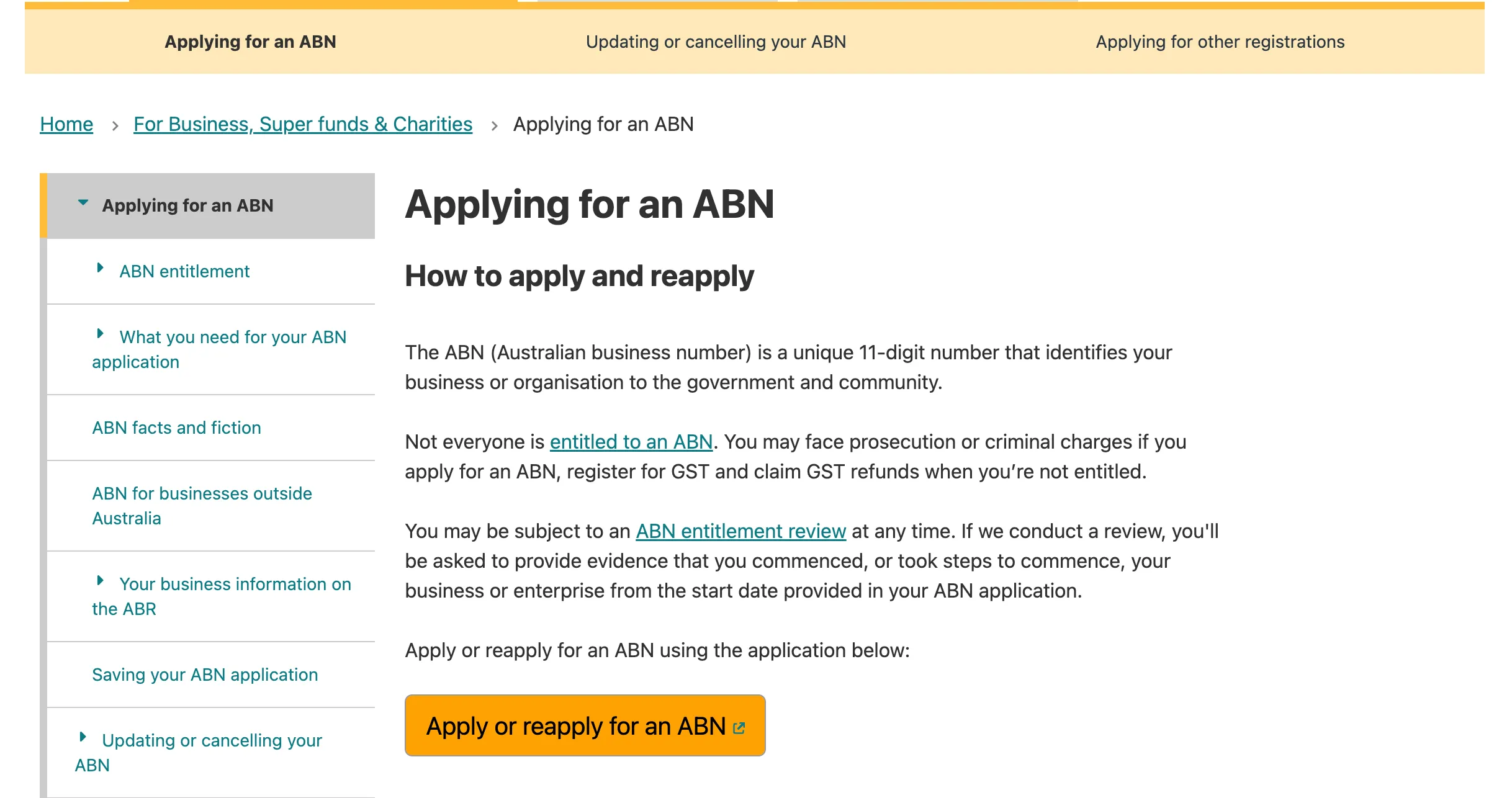
Applying for an ABN is free, but you need to be entitled to one. You can apply online at the Australian Business Register. Many applications are processed immediately, but some may take longer if more information is needed.
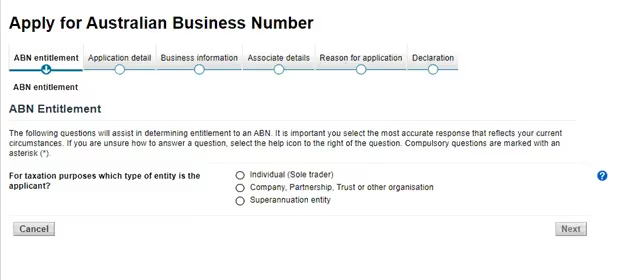
Once you click on apply, it will bring you to a disclaimer screen where you can agree and continue. After that step, your screen should look similar to this:
Business name
If you want to trade under a name other than your own legal name, you need to register a business name with the Australian Securities and Investments Commission (ASIC). For example, if your name is Sarah Chen and you want to trade as "Sparkle Clean Sydney," you need to register that name.
ASIC fees for business name registration are indexed annually from 1 July. Check the current ASIC fee schedule before registering. Registration is done through the ASIC business names register.
Registering a business name does not give you trademark protection. If you want to protect your brand, logo, or product names, consider registering a trademark separately through IP Australia.
Company registration (if applicable)
If you chose a company structure in Step 2, you also need to register the company with ASIC. This gives you an Australian Company Number (ACN). You need at least one director who is an Australian resident. If you are becoming a company director, you will need to apply for a director identification number before appointment. ASIC company registration fees are also indexed annually, so check current fees before applying.
Tip: the Australian Government Business Registration Service lets you apply for your ABN, business name, GST, and company registration in one place. This saves time and reduces the chance of missing a step.
Step 4: Register for GST and Understand Your Tax Obligations
GST
Goods and Services Tax (GST) registration is generally required if your business earns or expects to earn $75,000 or more in annual turnover. Once you are required to register, the ATO says you need to do so within 21 days. Once registered, you charge GST on your sales, claim GST credits on your business purchases, and lodge a Business Activity Statement (BAS) monthly or quarterly.
If your turnover is below $75,000, GST registration is optional. Some businesses register voluntarily so they can claim GST credits on purchases. Some businesses have different GST rules, including taxi and ride-sourcing services, so check your specific obligations with the ATO.
Other tax obligations
Depending on your business, you may also need to deal with PAYG withholding (if you hire employees or contractors who do not quote an ABN), superannuation (if you pay employees or certain contractors), payroll tax (state-based, applies above certain wage thresholds), and fringe benefits tax (if you provide non-cash benefits to staff like cars or phones).
Tip: set up a meeting with a registered tax agent or accountant before your first BAS is due. Getting tax right from the start saves stress and penalties later.
Step 5: Set Up Business Banking, Accounting, and Record Keeping
Keep your business finances separate from your personal finances from day one.
Open a business bank account. You will need your ABN and identification. Most Australian banks offer business accounts with accounting software integration.
Choose accounting software. Xero, MYOB, and QuickBooks are the most common for Australian small businesses. They handle invoicing, expense tracking, BAS preparation, and bank feeds.
Keep records. The ATO requires you to keep business records for at least five years, including invoices, receipts, bank statements, contracts, and tax returns.
Tip: set up your accounting software and bank feed before your first sale. Catching up on months of transactions later is one of the most common headaches for new business owners.
Step 6: Check Licences, Permits, and Industry Rules
Before you start trading, check whether your industry, location, or business type requires specific licences, permits, or registrations.
Building and trade licences for construction, plumbing, and electrical work
Food handling and safety permits for cafes, restaurants, and food businesses
Health practitioner registration for allied health, nursing, and medical professionals
Beauty and personal care permits depending on your local council
Liquor licences for businesses that sell alcohol
Childcare and education provider approvals
Real estate agent licences
Transport and logistics operator accreditation
Why this matters for insurance: some licences require you to hold specific insurance as a condition of the licence. For example, some licensed trades in certain states must hold public liability insurance. Some professional registrations require professional indemnity. Your licence conditions may specify a minimum cover level.
Check your licence requirements before arranging insurance so you know what cover levels and types are needed.
Step 7: Arrange Business Insurance
Business insurance should not be left until after launch. Many new businesses first need insurance when they sign a lease, win a client contract, rent a workspace, hire staff, buy equipment, or are asked for a Certificate of Currency.
Public and products liability may be relevant if clients, suppliers, or members of the public interact with your business. It may help cover third-party injury and property damage claims.
Professional indemnity may be relevant if you provide advice, consulting, designs, services, or recommendations. It may help cover claims that your professional work caused a client financial loss.
Business pack may be relevant if you have premises, stock, fit-out, equipment, or business interruption exposure.
Cyber insurance may be relevant if you store client data, take online bookings, accept payments, or rely on cloud systems.
Commercial motor may be relevant if you use vehicles for business travel between client sites.
Personal accident may be relevant if you are self-employed and want income support if injury or illness stops you from working. Workers compensation does not cover sole traders for their own injuries.
Workers compensation is generally required if you employ staff. Requirements vary by state and territory.
Management liability / D&O may be relevant if you have a company structure, directors, employees, or investor and governance exposure.
Which insurance suits your business type?
Different businesses face different risks. Here is a quick guide by business type.
Not every new business needs every type of insurance listed above. The right cover depends on your occupation, business structure, contracts, premises, staff, equipment, and risk profile.
Tip: arrange insurance before you sign your first lease or contract. Many landlords, clients, and head contractors require a Certificate of Currency before you can start work.
Step 8: Set Up Contracts, Invoices, and Basic Legal Documents
Before you start taking on clients, set up the documents that protect your business. Client agreements or terms and conditions set out what you will deliver, when, at what price, and what happens if something goes wrong. Even a simple one-page agreement is better than nothing.
Privacy policy may be needed if you collect personal information, especially if your business is covered by the Privacy Act or handles sensitive information such as health records. Even where not legally required, a privacy policy can help explain how you collect, use, and protect customer information.
Invoice template should include your business name, ABN, the date, a description of what you provided, the amount, GST (if registered), and payment terms.
Why this matters for insurance: many contracts specify insurance requirements. A client contract may require public liability at a minimum cover level. A lease may require business pack insurance. A head contractor may require a Certificate of Currency before you can start on site.
Step 9: Build Your Online Presence and Sales Channels
Most customers will search for your business online before contacting you. Register a domain name. Secure a .com.au or .au domain that matches your business name.
Set up a basic website. A one-page site with your business name, what you do, how to contact you, and your service area is enough to start. Squarespace, Wix, and WordPress are common options.
Claim your Google Business Profile. This is free and helps your business appear in Google Maps and local search results.
Accept online payments. Set up a payment gateway like Stripe, Square, or PayPal if you take bookings or sell products online.
Step 10: Launch, Review, and Stay Compliant
You have done the setup. Now launch and keep the business on track.
Before launch, confirm: ABN is active, business name is registered (if needed), GST registration is sorted, licences and permits are in place, insurance is arranged, banking and accounting are set up, contracts and terms are ready, and your website or online presence is live.
After launch, keep reviewing. Renew your business name and licences on time. Review your insurance annually or when the business changes (new staff, new premises, new services, higher revenue). Lodge your BAS on time. Keep financial records up to date. Revisit your business plan every 6-12 months. Update contracts if your services, pricing, or terms change.
Tip: set calendar reminders for every renewal date. Business name, insurance, licences, domain name, and annual ASIC review fees all have deadlines. Missing them can create compliance issues or coverage gaps.
upcover is a Corporate Authorised Representative (CAR 1299211) of Experience Insurance Services Pty Ltd ABN 41 657 596 506, AFSL 539078.
Frequently Asked Questions
How do I start a business in Australia?
Start by validating your idea and writing a simple business plan. Then choose a business structure (sole trader, partnership, company, or trust), register your ABN, register your business name with ASIC if needed, register for GST if applicable, check licences and permits, arrange business insurance, set up banking and accounting, prepare your contracts, and build an online presence.
How much does it cost to start a business in Australia?
Costs depend on your business type and structure. An ABN is free. ASIC business name registration and company registration fees are indexed annually from 1 July, so check the current ASIC fee schedule before applying. Other common startup costs include insurance, accounting software ($30-$80/month for most platforms), a website, equipment, stock, marketing, and professional advice. A sole trader service business can often get started for under $2,000 including registration, insurance, and basic setup, while a company with premises and staff will cost significantly more.
What business structure should I choose?
If you work alone and want simplicity, start as a sole trader. If you plan to grow, hire staff, or take on investors, a company (Pty Ltd) may be worth the extra setup, but directors still have personal duties. Partnerships and trusts suit specific situations. Talk to an accountant or business adviser before choosing because the right structure depends on your income, risk, growth plans, and personal circumstances.
Do I need an ABN to start a business?
Most businesses carrying on an enterprise in Australia need an ABN. You use it to invoice other businesses, register for GST, open a business bank account, and interact with government agencies. Applying is free through the Australian Business Register, but you need to be entitled to one.
Do I need an ABN if I earn less than $75,000?
An ABN is not tied to a specific income threshold. If you are carrying on an enterprise, you may need an ABN regardless of how much you earn. The $75,000 threshold applies to GST registration, not ABN registration. You can have an ABN without being registered for GST.
What insurance do I need to start a business in Australia?
It depends on your business type, structure, and activities. Common covers for new businesses include public liability, professional indemnity, business pack, cyber insurance, commercial motor, personal accident, and workers compensation if you employ staff. The right combination depends on your clients, contracts, premises, equipment, and industry. upcover arranges business insurance for Australian small businesses and sole traders across a wide range of occupations.
Do I need to register for GST?
You must register for GST if your business earns or expects to earn $75,000 or more in annual turnover. Below that threshold, registration is optional. Some businesses have different GST rules, including taxi and ride-sourcing services. Once registered, you charge GST, claim GST credits, and lodge a Business Activity Statement. Confirm your specific obligations with a registered tax agent.
What licences do I need to start a business?
Licence requirements vary by industry, state, territory, and local council. Use the Australian Business Licence and Information Service (ABLIS) at ablis.business.gov.au to check what applies to your business. Common examples include trade licences, food permits, health practitioner registration, beauty permits, liquor licences, and transport operator accreditation.
How do I open a company in Australia?
To open a company in Australia, choose a company structure, register the company with ASIC, obtain an Australian Company Number (ACN), apply for an ABN, and make sure directors understand their legal obligations. Directors may also need a director identification number before appointment. Company registration fees and annual review fees are set by ASIC and change over time, so check the current fee schedule before applying.
What are common mistakes when starting a business?
Common mistakes include choosing the wrong business structure, not separating personal and business finances, underestimating startup costs, skipping insurance until a client or landlord asks for it, not registering for GST when required, ignoring licence and permit requirements, and not keeping proper financial records from day one. Most of these are avoidable by following the steps in this guide.
The information in this article is general in nature and provided for informational purposes only. It does not constitute personal insurance, legal, financial, tax, or business advice. Business registration requirements, ASIC fees, GST thresholds, licence conditions, and insurance requirements can change. Always confirm current requirements with the relevant government agency, a registered tax agent, an accountant, or a qualified adviser before acting. All insurance products arranged through upcover are subject to the terms, conditions, limits and exclusions contained in the relevant policy wording and Product Disclosure Statement. Before deciding whether a particular insurance product is right for you, please read the relevant PDS and consider your personal circumstances. upcover Pty Ltd ABN 17 628 197 437 is a Corporate Authorised Representative (CAR 1299211) of Experience Insurance Services Pty Ltd ABN 41 657 596 506, AFSL 539078. upcover arranges insurance products with selected insurers and underwriters and does not compare all general insurers or insurance products available in the market.
To get public liability insurance online, request a quote, answer questions about your business, check the policy, then get your certificate of currency.
Social engineering explained: phishing, invoice scams, vishing and smishing, warning signs, prevention steps and how cyber or crime insurance may respond.
We are digitising commercial insurance and risk management for small, mid-market and technology businesses. We work with a global network of underwriters, challenging legacy brokers and delivering market leading coverage to our customers.
The information contained on this website is general advice only and has been prepared without taking into account your individual needs, objectives and financial situation. It should not be relied upon as advice. All insurance products are subject to the terms, conditions, limits and exclusions contained in the relevant policy wording and Product Disclosure Statement. Before deciding whether a particular insurance product is right for you, please consider your personal circumstances and read the relevant Product Disclosure Statement, Target Market Determination, Policy Wording, and Financial Services Guide.

.svg)



.svg)
.svg)
.svg)
%201.svg)


.svg)




.svg)


