Select how you’d like to proceed with your insurance needs.
Schedule a Call Today
Talk to a real insurance expert on your time.
BOOK A CONSULTATION
WHAT’S IN THIS STEP
15-minutes consultation with licensed advisors
Perfect if you’re unsure about coverage needs
Get personalised recommendations
Make upcover your insurance broker
Already have coverage? Let’s simplify your service
CHANGE BROKER
WHAT’S IN THIS STEP
Keep your current carriers & policies
Simple digital authorisation process
Seamless transition to better service
Beauty & Personal Care
Beautician vs Beauty Therapist: What's The Difference?
June 12, 2026
6 Mins Read
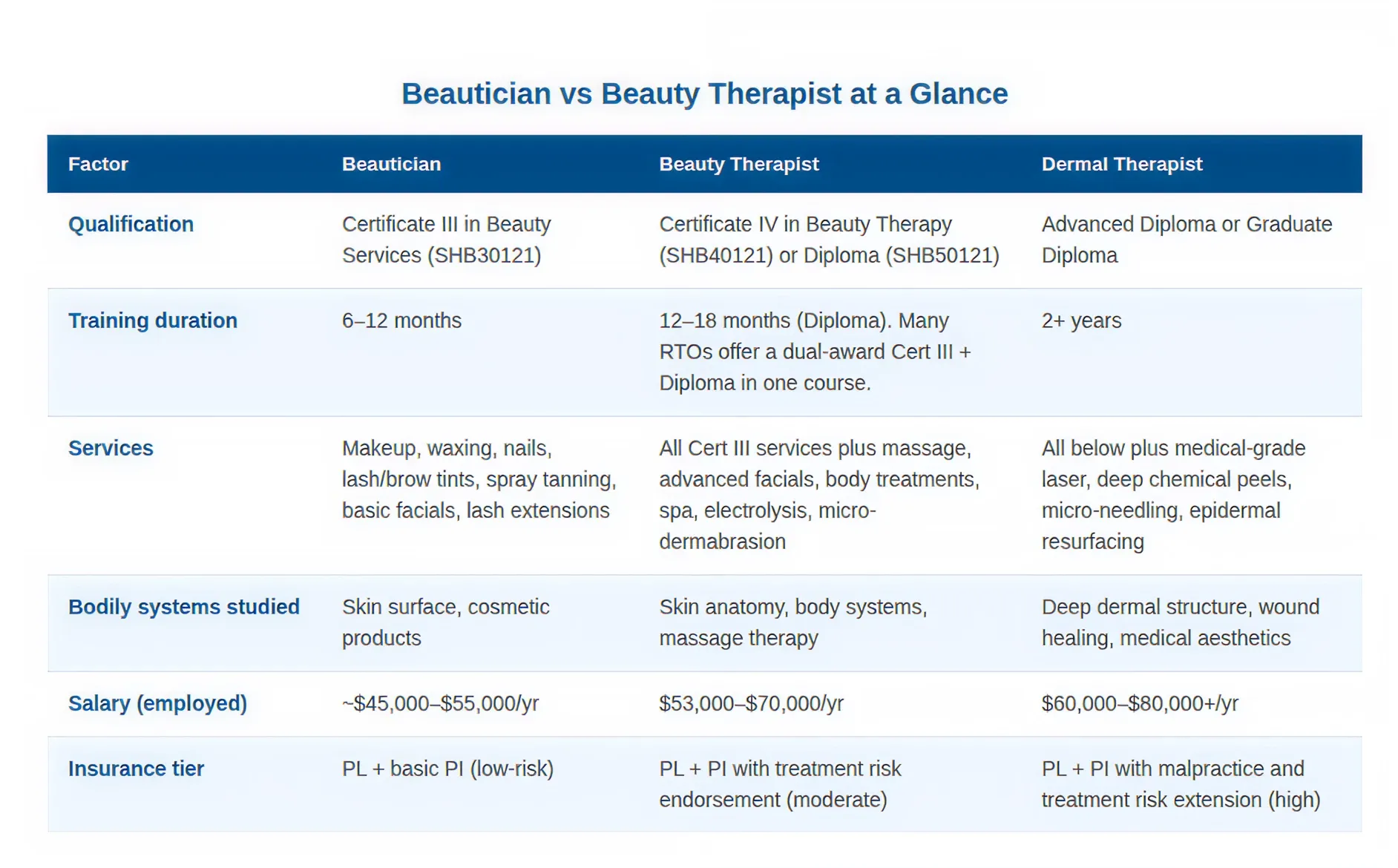
A beautician holds a Certificate III in Beauty Services and performs surface-level cosmetic treatments like makeup, waxing, nails, and lash tints. A beauty therapist holds a Certificate IV or Diploma in Beauty Therapy and performs advanced treatments including massage, chemical peels, micro-dermabrasion, and electrical facial therapies.
The difference comes down to three things: the qualification level, the scope of services each can legally perform, and the insurance risk profile. A beautician works on the surface. A beauty therapist works deeper into the skin and body. The higher the qualification, the more advanced the treatments, and the more specialised the insurance cover required.
The Australian beauty industry is self-regulated. No single national licence is required to work as a beautician or beauty therapist. But employers, clients, and insurers expect nationally recognised qualifications, and your insurance policy must match the treatments you actually deliver.
What Is the Difference Between a Beautician and a Beauty Therapist in Australia?
Who Should You Book? A Quick Guide for Clients
If you are trying to figure out which professional to book for your next appointment, here is the simple breakdown.
Book a beautician for: everyday makeup, bridal or event makeup, waxing (face, body, bikini), manicures and pedicures, lash and brow tinting, lash extensions, spray tanning, and basic hydration facials.
Book a beauty therapist for: advanced skin correction facials, machine-based treatments (ultrasonic, galvanic, high-frequency), micro-dermabrasion, chemical peels, full-body massage (Swedish, aromatherapy, hot stone), body wraps, spa treatments, and electrolysis.
Book a dermal therapist for: medical-grade laser treatments, IPL hair removal, clinical skin needling (micro-needling), and deep chemical peels targeting scarring or hyperpigmentation.
If you are unsure, ask the salon or clinic which qualification their practitioner holds. The qualification determines what treatments they can safely and legally perform.
What Is a Beautician?
A beautician is a beauty professional who typically holds a Certificate III in Beauty Services (SHB30121). The course takes 6 to 12 months through a TAFE or registered training organisation (RTO) and covers the foundations of the beauty industry.
What does a beautician do? A beautician performs surface-level cosmetic treatments. These include:
Makeup application (bridal, event, photographic)
Waxing (face, body, bikini)
Manicures, pedicures, and nail art
Lash and brow tinting
Lash lifts and lash extensions
Spray tanning
Basic facials (cleanse, tone, moisturise)
A beautician does not perform treatments that penetrate below the skin surface, use electrical facial devices, or involve deep tissue manipulation. There are no mandatory certification requirements to work as a beautician in Australia, but the Certificate III is the industry standard. Employers and insurers expect it.
What Is a Beauty Therapist?
A beauty therapist holds a Certificate IV in Beauty Therapy (SHB40121) or a Diploma of Beauty Therapy (SHB50121). Beauty therapist meaning: a qualified professional trained to deliver advanced beauty and skin treatments beyond basic cosmetic grooming.
What does a beauty therapist do? Everything a beautician does, plus:
Swedish and aromatherapy body massage
Advanced facials using electrical equipment such as ultrasonic, galvanic, and high-frequency devices (unit SHBBFAS006)
Micro-dermabrasion (unit SHBBSKS009)
Body wraps and spa treatments
Electrolysis (permanent hair removal)
Skin analysis and treatment planning
Diploma holders may also perform chemical peels and salon management. Advanced treatments such as IPL, laser, skin needling, and deeper chemical peels may require additional training, supervision, licence/registration, or radiation-safety compliance depending on the state or territory and treatment type. Check the relevant state regulator and insurer before offering these services.
Most modern Australian RTOs now offer a dual-award pathway that packages the Certificate III and the Diploma into a single 12 to 18 month course. This allows students to go straight from entry level to diploma-qualified without completing the Certificate IV as a separate step.
What Is a Dermal Therapist?
A dermal therapist sits above a beauty therapist on the qualification ladder. They hold an Advanced Diploma or Graduate Diploma and perform clinical-grade skin treatments.
Dermal therapists work with medical-grade laser equipment, perform deep chemical peels, carry out micro-needling, and deliver epidermal resurfacing treatments. They typically work in skin clinics or medispas under clinical protocols rather than in general beauty salons.
If you are considering moving from beauty therapy into dermal therapy, you will need additional qualifications and a higher level of insurance cover.
What Does "Independent Beautician" Mean?
An independent beautician is a sole trader running their own beauty business rather than working as an employee in someone else's salon.
An independent beautician may:
Work from a home studio
Operate as a mobile beautician visiting clients at their homes
Own insurance. An independent operator is not covered by any employer's policy. You need your own public liability and professional indemnity cover. upcover arranges both for independent beauty professionals.
Council premises registration if performing any skin penetration treatments (cosmetic tattooing, micro-needling). See upcover's cosmetic tattoo requirements checklist.
GST registration if annual turnover exceeds $75,000.
This is the detail no beauty academy or career blog covers. Your insurance policy is rated based on your declared qualification and your declared service list. If you hold a Certificate III but perform treatments that require a Certificate IV or Diploma (such as micro-dermabrasion, chemical peels, or electrical facial devices), your professional indemnity policy may not respond to a claim.
Insurers check the treatment against your qualification at claims time. If the treatment exceeds your formal qualification scope, the insurer can decline the claim. Your qualification must match your services, and your insurance must cover both.
Insurance for Beautician (Certificate III)
A beautician performing standard surface treatments needs:
Public liability insurance. May help cover claims if a client is injured at your premises or by your equipment, subject to policy terms
Professional indemnity insurance. May help cover claims from your service delivery (for example, an allergic reaction to a tint product or a wax burn), subject to policy terms
This is rated as low-risk by underwriters because the treatments do not penetrate the skin or use electrical devices.
Insurance for Beauty therapist (Certificate IV or Diploma)
A beauty therapist performing advanced treatments needs:
Public liability insurance
Professional indemnity insurance with a treatment risk endorsement. This may help cover claims arising from the treatment itself, such as micro-dermabrasion scarring, chemical peel burns, or injury from an electrical facial device, subject to policy terms
Products liability insurance if selling or recommending skincare products to clients
Treatment risk cover matters because standard PI may not respond to claims where the procedure itself caused the harm.
Insurance for Dermal therapist
A dermal therapist performing medical-grade treatments needs:
Public liability insurance
Professional indemnity insurance with explicit malpractice and treatment risk extensions
Higher premium reflecting higher-risk procedures
upcover arranges professional indemnity, public liability, and products liability insurance for beauticians, beauty therapists, and dermal therapists across Australia. See the beauty therapists and beauty salons insurance page for more detail.
How upcover Arranges Insurance for Beauty Professionals
upcover is a digital-first insurance broker helping Australian beauty professionals arrange the right insurance without the paperwork or phone queues. upcover arranges public liability, professional indemnity, and products liability insurance for beauticians, beauty therapists, salon owners, and independent operators across Australia, with access to 80+ insurance partners.
70,000+ businesses covered across Australia.
4.9/5 customer rating.
Instant Certificate of Currency on policy confirmation.
upcover Pty Ltd ABN 17 628 197 437 is a Corporate Authorised Representative (CAR 1299211) of Experience Insurance Services Pty Ltd ABN 41 657 596 506, AFSL 539078.
What is the difference between a beautician and a beauty therapist?
A beautician holds a Certificate III (SHB30121) and performs surface cosmetic treatments like makeup, waxing, nails, and tinting. A beauty therapist holds a Certificate IV (SHB40121) or Diploma (SHB50121) and performs advanced treatments including massage, micro-dermabrasion, chemical peels, and electrical facial therapies. The difference is the qualification level and the scope of services.
What qualifications do you need to be a beautician in Australia?
No formal qualification is legally required because the Australian beauty industry is self-regulated. However, the industry standard is a Certificate III in Beauty Services (SHB30121), which takes 6 to 12 months at a TAFE or RTO. Employers and insurers expect this qualification.
What does a beauty therapist do that a beautician cannot?
A beauty therapist can perform massages, advanced facials using electrical devices (ultrasonic, galvanic, high-frequency), micro-dermabrasion, body wraps, spa treatments, and electrolysis. Advanced treatments such as IPL, laser, skin needling, and deeper chemical peels may require additional training, supervision, licence/registration, or radiation-safety compliance depending on the state or territory and treatment type. Check the relevant state regulator and insurer before offering these services.
What does "independent beautician" mean?
An independent beautician is a sole trader running their own beauty business rather than working as an employee. They may work from a home studio, operate as a mobile beautician, or rent a chair in an existing salon. Independent operators need their own ABN, their own public liability and professional indemnity insurance, and council registration if performing any skin penetration treatments.
Do beauticians need insurance?
If you work independently (not as an employee), you need your own insurance. Public liability may help cover claims if a client is injured at your premises. Professional indemnity may help cover claims from your service delivery, such as allergic reactions or burns. Most salons, platforms, and commercial landlords require a Certificate of Currency before engaging an independent beautician.
Can a beautician do micro-needling or chemical peels?
No. Micro-needling and chemical peels require a Certificate IV or Diploma-level qualification. If a Certificate III beautician performs these treatments, their professional indemnity insurance may not respond to a claim because the treatment exceeds their formal qualification scope. Refer clients to a qualified beauty therapist or dermal therapist for advanced skin treatments.
The information in this article is general in nature and provided for informational purposes only. It does not constitute personal career, legal, or insurance advice. Qualification codes and training package details are based on publicly available information from training.gov.au current at the time of writing and may change following updates by the Australian Skills Quality Authority (ASQA). Salary figures are indicative based on publicly available 2026 market data. All insurance products arranged through upcover are subject to the terms, conditions, limits and exclusions contained in the relevant policy wording and Product Disclosure Statement. Before deciding whether a particular insurance product is right for you, please read the relevant PDS and consider your personal circumstances. upcover Pty Ltd ABN 17 628 197 437 is a Corporate Authorised Representative (CAR 1299211) of Experience Insurance Services Pty Ltd ABN 41 657 596 506, AFSL 539078. upcover arranges insurance products with selected insurers and underwriters and does not compare all general insurers or insurance products available in the market.
What insurance does a food truck need? Public and products liability, motor and staff cover explained, plus the limits councils and event organisers set.
What insurance does a subcontractor need? Public liability, tools, income and workers' comp explained, and whether the head contractor's policy covers you.
We are digitising commercial insurance and risk management for small, mid-market and technology businesses. We work with a global network of underwriters, challenging legacy brokers and delivering market leading coverage to our customers.
The information contained on this website is general advice only and has been prepared without taking into account your individual needs, objectives and financial situation. It should not be relied upon as advice. All insurance products are subject to the terms, conditions, limits and exclusions contained in the relevant policy wording and Product Disclosure Statement. Before deciding whether a particular insurance product is right for you, please consider your personal circumstances and read the relevant Product Disclosure Statement, Target Market Determination, Policy Wording, and Financial Services Guide.

.svg)



.svg)
.svg)
.svg)
%201.svg)


.svg)






.svg)


